
AUTO
CNG and Hybrids Push Alternative Fuels Past Petrol
CNG, not electric cars, drove India’s first month in which alternative fuels edged past petrol, at 41.95 percent versus 40.85 percent.

CNG, hybrid and electric cars together took 41.95 percent of India’s passenger vehicle retail in August, edging petrol at 40.85 percent. The Federation of Automobile Dealers Associations released that print on September 7 and called it the first time the three fuels combined have passed petrol.
Compressed natural gas did the heavy lifting at 25.28 percent. Battery cars were 7.63 percent. Petrol is still the largest fuel on its own.
A One-Point Crossover After Eleven Points of Lead
The gap is 1.10 points, not a collapse. A year earlier petrol/ethanol held 46.37 percent and the alternative basket 35.26 percent, an 11.11-point lead that dealers have now watched disappear. In July the same contest was 41.68 percent petrol against 40.59 percent for the basket, so August was the month the line finally flipped.
FADA’s August vehicle retail data put passenger-vehicle registrations at 4,02,398 units, up 16.14 percent from a year earlier and the first August above four lakh, though 3.40 percent below July. Sai Giridhar, the association’s president, said a little over a year ago petrol led this contest by nearly eleven percentage points and that lead has now been erased.
He also asked that the volume headline be read with discipline, because much of the year-on-year strength sits on a soft August 2025 base when buyers waited for the GST 2.0 rate cut. Total auto retail was 24,23,201 units, up 17.51 percent from 20,62,038 a year earlier and down 6.48 percent from July.
THE AUGUST PASSENGER-CAR FUEL MIX
| Fuel | August 2026 share | August 2025 share |
|---|---|---|
| Petrol/ethanol | 40.85% | 46.37% |
| CNG/LPG | 25.28% | 21.47% |
| Diesel | 17.21% | n/a |
| Hybrid | 9.04% | 7.96% |
| Electric | 7.63% | 5.83% |
Petrol’s share fell 5.52 points year on year. CNG rose 3.81 points, electric 1.80 points and hybrids 1.08 points, which is why a combined label can pass petrol while no single rival yet beats it.
CNG Now Accounts for One in Four Cars
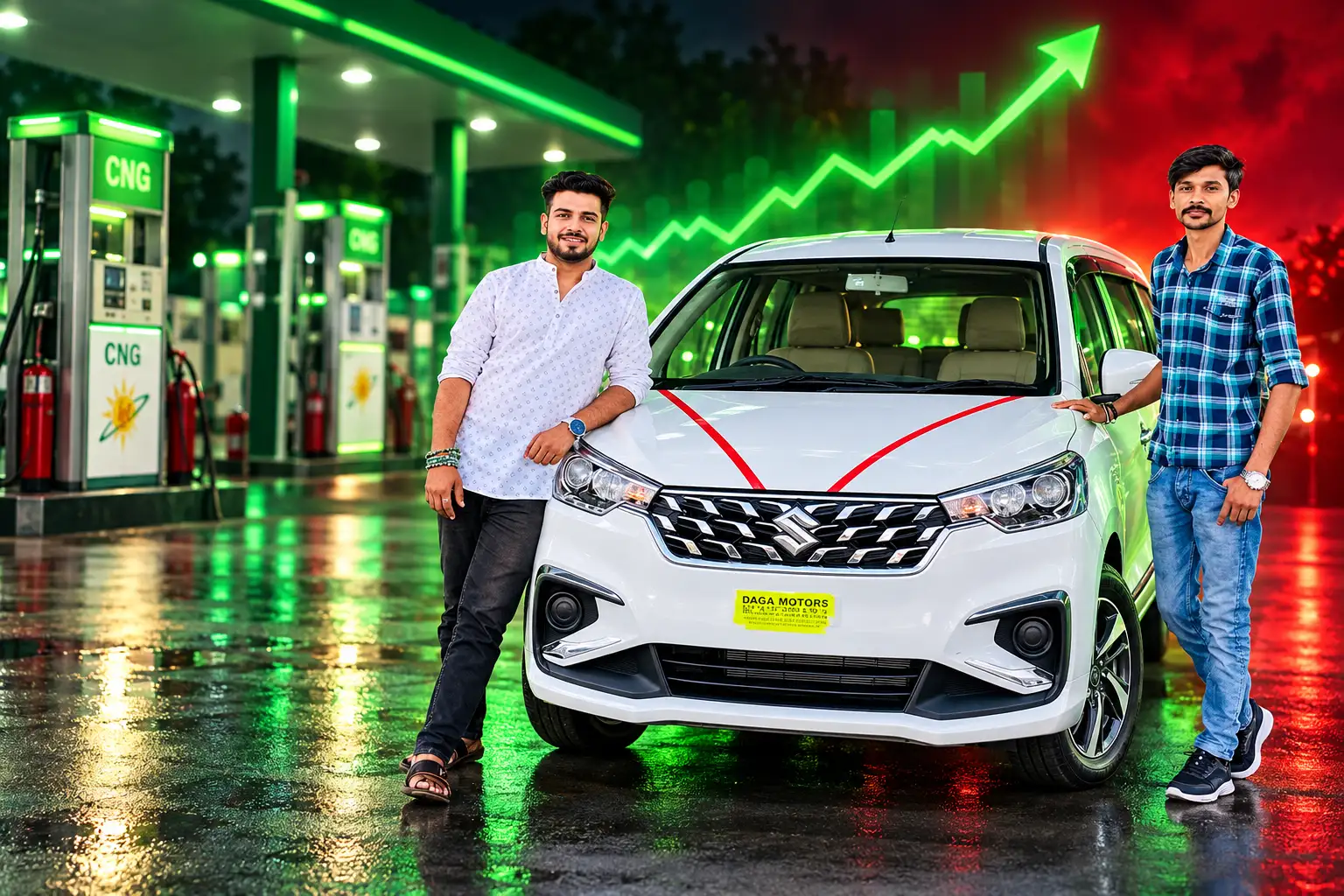
One in four new passenger vehicles retailed in August was a CNG or LPG model. That is a larger slice than diesel at 17.21 percent, and more than three times the electric share. Factory gas kits have moved from a city-fleet option into hatchbacks, sedans and compact SUVs that sell in the heart of the market.
Nearly 92 percent of the cars retailed in August still had an engine. Grouping CNG and hybrids with battery cars hides that. CNG burns methane. Hybrids still burn petrol, including the E20 blend at the pump. The month that supposedly retired petrol’s lead still sold far more cars that refill from a nozzle than cars that plug in.
July already showed where the extra point would come from. CNG’s share then was 24.67 percent and hybrids 8.02 percent, while electric cars were 7.90 percent. August lifted gas and hybrids and let the electric slice slip to 7.63 percent. The crossover was not an EV surge that arrived in the monsoon.
Running cost is the plain reason dealers give. CNG still undercuts petrol per kilometre for high-use cars, and the payback is short enough that private buyers, not only taxi fleets, now tick the CNG box on the order form.
Showrooms Are Hearing the E20 Complaint
Dealers also point at pump petrol itself. India has made E20, petrol with 20 percent ethanol, the standard fuel at regular pumps after compressing a 20 percent ethanol blending target that the National Policy on Biofuels had first aimed at 2030. The petroleum ministry has said the blend may cut mileage by 3 to 5 percent, and it has ruled out restoring E0 or E10 at ordinary pumps because parallel nationwide supply chains would raise logistics and handling costs across more than one lakh outlets.
A ministry FAQ on ethanol blending still frames the programme as a way to cut oil imports and raise octane. Premium grades such as XP100, poWer100 and Speed100 stay ethanol-free, which is a narrow escape hatch at a higher price. Puneet Gupta, director at research firm Mobility Global, has said more than 75 percent of vehicles on Indian roads are not E20-compliant, a mismatch that has fed mileage complaints on older petrol cars.
Dealers attribute the shift to running-cost economics and continuing consumer hesitation around the E20 transition, which is nudging petrol buyers towards CNG, hybrids and EVs.
Sai Giridhar, President, Federation of Automobile Dealers Associations
That nudge is showing up as CNG tickets, not as a rush to charge points. Amar Jatin Seth, FADA vice-president, said the fuel-mix change is also tied to geopolitical pressure on fuel prices and that CNG’s share is already very high, making it a larger contributor than diesel, with carmakers pushing more CNG models. People who hoped ethanol would shove households straight into electric cars got a different ticket printed in August.
Why Petrol Is Still the Largest Single Fuel
Petrol/ethanol at 40.85 percent remains the biggest individual category, larger than CNG, diesel, hybrids or electric cars. The “overtake” only exists because FADA added three unlike powertrains and compared the sum with petrol. Split the basket and petrol still wins the showroom.
That matters for oil demand, workshop work and what gets built next. Ancillary firms that live on engines, tanks and exhausts are not staring at an electric cliff on this print. They are staring at a smaller petrol share and a much larger CNG share, with hybrids as a third petrol-burning path that avoids the charging-point argument.
Giridhar’s own statement kept the qualifier in the same breath as the milestone: petrol still remains the single largest individual fuel. The 1.10-point gap can reverse in a month if CNG supply tightens, if hybrid discounts fade, or if festive petrol hatchbacks simply out-retail the rest.
Maruti’s Factory Gas Kits Did the Heavy Lifting
Maruti Suzuki retailed 1,65,200 passenger vehicles in August for a 41.05 percent share of the car market, ahead of Tata Motors at 14.37 percent, Mahindra & Mahindra at 12.49 percent and Hyundai at 11.68 percent. The CNG story underneath those totals is even more lopsided. In FY2026, when CNG cars crossed 10.14 lakh units and about 21.7 percent of passenger-vehicle sales, Maruti took about 7.07 lakh of them, roughly 70 percent of the segment.
Partho Banerjee, Maruti’s sales and marketing head, has said the company now offers 15 factory-fitted CNG models and is aiming for 9 lakh CNG sales this fiscal. About half of WagonR demand is CNG, and he has said almost 50 percent of Victoris demand is now the underbody CNG variant, a layout that stops the tank from swallowing the boot. The Ertiga led FY2026 CNG nameplates with 1,45,480 units, with the Dzire, WagonR and Brezza close behind.
Tata has used CNG on the Nexon and Punch as well as a wide electric range, and Tata Motors said its electric-car share was about 43 percent in August. Mahindra has largely stayed out of CNG and leaned on diesel SUVs plus electric models. The August mix rewards the carmaker that already tooled gas kits across hatchbacks people actually buy, not the one waiting for charging coverage to catch up.
Electric Cars Hold Less Than Eight Percent
Electric passenger cars at 7.63 percent are growing off a small base, up 1.80 points from a year earlier, and they still trail hybrids at 9.04 percent. Across every vehicle category FADA counted 2,98,448 electric retails in August, up 52.9 percent year on year, lifting overall electric share to about 12.3 percent from 9.5 percent. Most of that volume is not cars.
WHERE ELECTRIC SHARE ACTUALLY SITS
- Two-wheelers: Electric share reached 10.68 percent, the first time it has crossed 10 percent in a non-festive month, up from 7.66 percent a year earlier, while petrol/ethanol still held 89.23 percent.
- Three-wheelers: Electric models took 65.30 percent of 1,22,281 retails, a category FADA now calls structurally electric.
- Commercial vehicles: Electric share rose to 5.18 percent from 2.06 percent a year earlier, more than doubling, on 90,769 total CV retails.
- Passenger cars: Battery models remain the smallest of the three “alternative” slices at 7.63 percent, and they lost a little ground from July’s 7.90 percent.
Two-wheeler electric share also slipped from 11.24 percent in July to 10.68 percent in August, so the non-festive 10 percent crossing is real and still fragile. The vehicles that have gone electric in India are scooters and three-wheelers with short daily routes. The family car, on this print, went to the gas pump.
Rural Registrations Grew More Than Twice as Fast
Rural passenger-vehicle retails rose 24.99 percent year on year, more than twice the 10.93 percent urban pace. Across all categories rural grew 19.79 percent against 15.17 percent in cities. Rural commercial vehicles were up 16.33 percent and rural three-wheelers 23.95 percent, even as urban three-wheelers fell. Tractors were the exception, flat at 0.84 percent year on year and down 25.03 percent from July, which Giridhar tied to a monsoon deficit of around 13 percent.
That split helps explain why CNG, not electric cars, took the extra point. Gas kits sell where pumps already exist and where running cost dominates the monthly budget. Charging coverage is still a city argument. Banerjee has said some buyers even take a CNG car before a local station opens and run on petrol in the meantime, which is a vote for the kit, not for the grid.
The channel is not loose. Passenger-vehicle inventory rose another five days from the end of July to around 38 to 40 days, well above FADA’s 21-day benchmark, and 56 percent of PV dealers reported higher stock month on month. Giridhar urged carmakers to bill to retail so dealer capital is not stuck in ageing inventory as festive stocking begins. For September, 67.09 percent of dealers expected growth, down from 74.30 percent heading into August; 27.35 percent expected a flat month and 5.56 percent a decline.
The first month in which the alternative-fuel basket passed petrol still sold more petrol cars than CNG cars, and several times more petrol cars than electric ones. Petrol remains the largest single fuel. CNG is the fuel that actually moved the line.
Frequently Asked Questions
What Does FADA Count as Alternative Fuels in Car Sales?
The dealer body groups CNG and LPG with hybrids and battery-electric cars, and it records petrol as petrol/ethanol because pump petrol is now the E20 blend, with diesel kept in a separate bucket. That grouping is why three unlike powertrains can be said to have passed petrol even though none of them, on its own, outsold it in August.
How Many CNG Passenger Vehicles Did India Sell in FY2026?
Factory CNG cars crossed 10.14 lakh units in FY2026, about 21.7 percent of passenger-vehicle sales, and Maruti Suzuki accounted for about 7.07 lakh of those units, or roughly 70 percent of the segment, led by the Ertiga at 1,45,480 units.
Will Regular Pumps Sell E10 or Ethanol-Free Petrol Again?
The petroleum ministry has said there is no proposal to restore E0 or E10 at regular pumps, citing the cost of running parallel nationwide supply chains, while premium grades such as Indian Oil’s XP100, HPCL’s poWer100 and BPCL’s Speed100 remain ethanol-free.
Who Followed Tata Motors in Electric Passenger Cars in August?
Vahan figures compiled by Nuvama put Mahindra & Mahindra second with 6,367 electric passenger-car registrations and a 21 percent share, JSW MG Motor India third at 4,568 units and 15.1 percent, VinFast fourth at 2,196 units and 7.2 percent, and Maruti Suzuki at 1,391 units and 4.6 percent, on 30,325 electric passenger-car registrations in the month.

Brain-IT Rebuilds Seen Images After One Hour of Scans

Middle East Oil Tops Pre-War Marks by Skipping Hormuz

Peacock’s Fast Series Shares 2028 With Fast Forever

NASA and IBM’s Lunar Model Cuts Polar Ice-Map Error

SteelSeries Sells Infinite 8K Mice That Still Need a Dock

Micron’s $22 Billion Deposits Cover Only a Fifth of DRAM

OnePlus 16 Bets on 200MP and a Familiar 3x Sony

C Spire Plans a 200-Mile Fiber Line for One Customer

How to Change Background Color in Epic Hyperspace – Personalizing Your EHR Interface

Types of Alligators in Florida – Discovering Reptilian Diversity in the Sunshine State
-
 BUSINESS2 months ago
Micron’s $22 Billion Deposits Cover Only a Fifth of DRAM
-
 NEWS2 months ago
OnePlus 16 Bets on 200MP and a Familiar 3x Sony
-
 NEWS1 month ago
C Spire Plans a 200-Mile Fiber Line for One Customer
-
 TECHNOLOGY3 years ago
How to Change Background Color in Epic Hyperspace – Personalizing Your EHR Interface
-
 LIFESTYLE3 years ago
Types of Alligators in Florida – Discovering Reptilian Diversity in the Sunshine State
-

 NEWS2 months ago
The AI Boom Arrived and Workers’ Share Hit a Record Low
-

 LIFESTYLE3 years ago
Gag Reflex Removal Surgery Cost – Exploring Treatment Expenses for Gag Reflex Management
-

 NEWS2 months ago
Debian Puts Generative AI Risk on Volunteer Submitters