
NEWS
Super Micro Looks Cheap Until You Read the Cash
SMCI screens at 11.8 times earnings after a 978% five-year run, but fiscal 2026 used $6.81 billion of cash and Q1 gross margin is guided back near 11%.

Super Micro Computer stock trades at about 11.8 times earnings after a year that used $6.81 billion of operating cash. The shares closed at $39.59 on September 4, 2026, valuing the San Jose server maker at $26.0 billion after a 978% five-year total return.
A September 2026 discounted cash flow model from Simply Wall St still prints about $47 a share, 16.5% above the price that run used, and the same note scores the stock 4 out of 6 on broader valuation checks. Cisco will take orders in October for Super Micro GPU servers inside its Secure AI Factory line. Fiscal 2026 profits and fiscal 2026 cash did not tell the same story, and that gap is what the multiple is pricing.
Super Micro Screens Cheap Because Cash Went the Other Way
On earnings, Super Micro Computer, Inc. (NASDAQ: SMCI) looks inexpensive next to other tech names. The 11.8 times multiple sits under a tech-sector average near 20.1 times and a peer group near 48.6 times, and Simply Wall St’s modelled fair multiple is about 41.7 times. A $1,000 stake held for five years would have been worth about $10,782 on that 978% total return.
Founder, chairman, and chief executive Charles Liang called fiscal 2026, which ended June 30, a jump from $22 billion of sales to $39.1 billion as the firm tries to sell full data-center stacks rather than boxes. Chief financial officer David Weigand said non-GAAP earnings reached $3.63 a share, up from $2.06, while GAAP diluted earnings were $3.26 against $1.68. Non-GAAP operating margin widened to 8.1% from 7.1%.
Those income-statement wins arrived with a cash-flow hole large enough to force a $5.6 billion equity raise in June, $1.4 billion of common stock and $4.2 billion of mandatory convertible preferred, which Weigand said would fund working capital for new orders. Net debt fell to $1.2 billion from $7.5 billion after that raise, which is recapitalization, not conversion of GPU racks into cash.
THE MULTIPLE AGAINST THE CASH
- Market value: $26.0 billion at the September 4, 2026 close of $39.59.
- Earnings multiple: about 11.8 times fiscal 2026 profit, versus 20.1 times for tech and 41.7 times on the modelled fair ratio.
- Cash from operations: $6.81 billion used in fiscal 2026, against $1.66 billion provided in fiscal 2025.
- Modelled worth: about $47 a share on the September 2026 discounted cash flow run, 16.5% above the market that model used.
Holders who treat 11.8 times as leftover upside after the AI run are reading the income statement and skipping the cash statement. The order book can support a higher sales number. It has not yet supported a higher quality of earnings.
9.59 stock cash hole versus profits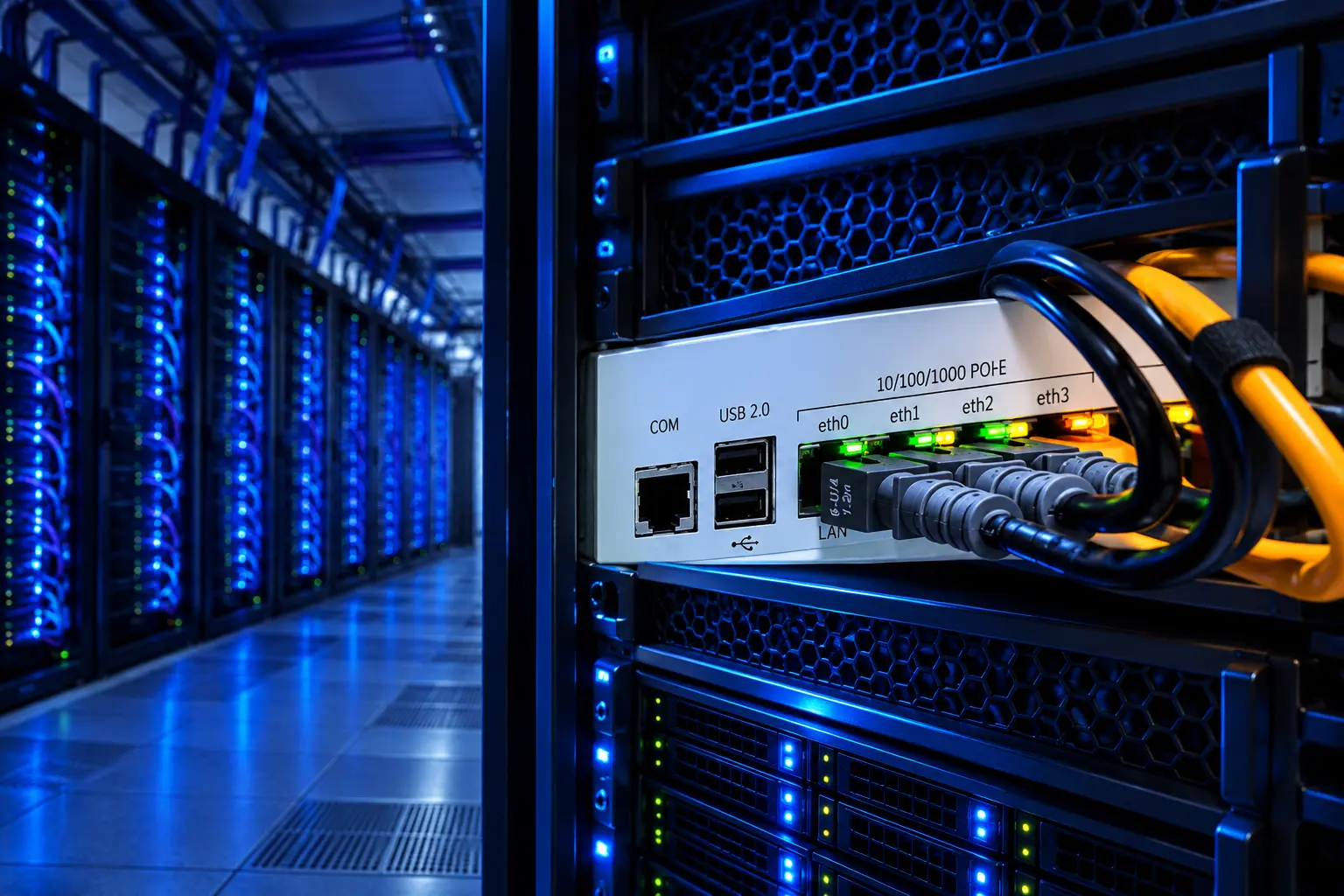
Inventory Ate $8.88 Billion of Super Micro’s Cash
The fiscal 2026 10-K records net income of $2.23 billion and net cash used in operating activities of $6,809.9 million. Receivables absorbed $3.92 billion. Inventory purchases absorbed $8.88 billion, which is why year-end stock sat at $12.9 billion of inventories at year end against $4.68 billion a year earlier. Capex was only $162 million, so the drain is working capital, not factories.
SALES, PROFIT, AND CASH ACROSS THE AI YEAR
| Metric | FY2025 | FY2026 | Q4 FY2026 |
|---|---|---|---|
| Net sales | $22.0 billion | $39.1 billion | $11.1 billion |
| Net income | $1.05 billion | $2.23 billion | $1.18 billion |
| Operating cash flow | $1.66 billion | $(6.81) billion | $747 million |
| Period-end inventory | $4.68 billion | $12.90 billion | $12.90 billion |
| Non-GAAP gross margin | 11.2% | 10.9% | 17.6% |
Fourth-quarter cash did flip. Operations provided $747 million, and free cash flow was $722 million after $25 million of capital spending and investments, against $6.6 billion used in the third quarter. The cash conversion cycle still stretched to 149 days from 106, as days of inventory rose to 119 from 106 while the company built stock for fiscal 2027. Days sales outstanding dropped to 59 from 85 after collections, and days payables collapsed to 29 from 85 after a large GPU project was paid through.
Weigand said the cycle should normalize on terms in the current backlog. Until it does, Super Micro is a rack assembler that buys Nvidia-class silicon, memory, and cooling gear before customers take delivery, and right now the working-capital account is beating the income statement. Cash on the balance sheet was $7.5 billion against $8.7 billion of bank debt and convertibles, a war chest filled by investors, not by collections.
Guidance Puts Gross Margin Back Near 11%
The quarter that excited the earnings tape was also the quarter management is not asking anyone to underwrite again. Non-GAAP gross margin hit 17.6% in the fourth quarter, against guidance of 8.2% to 8.4% issued earlier and 10.1% in the third quarter, a 750 basis-point sequential jump. GAAP gross margin was 17.5%. Full-year non-GAAP gross margin still slipped to 10.9% from 11.2%, so the year as a whole got worse on that line while one quarter got much better.
Weigand split the fourth-quarter gain in plain terms. About 75% came from a better customer and product mix, including contracts deferred from the fourth quarter into the first quarter of fiscal 2027. The other 25% came from lower tariff costs and lower inventory reserves. Enterprise and channel sales were $5.6 billion, or 50% of the quarter, up from 28% in the third quarter, while OEM appliance and large data-center sales fell 26% sequentially to $5.5 billion. AI solutions were about 60% of fourth-quarter sales after more than 80% in the third quarter, a mix shift that helped the margin and cut the AI share in the same breath.
For the quarter ending September 30, 2026, the company guided gross margin to 10.4% to 10.8%. That band sits on top of the full-year 10.9% result and far below the 17.6% print. Second-quarter gross margin had been 6.4% when a single large data-center customer dominated the book. Anyone capitalizing Super Micro as a mid-teens margin AI franchise is using a quarter that the company’s own outlook puts back near 11%.
63 Percent of One Quarter, 28 Percent of the Year
Customer concentration is the other reason a low multiple can be rational. In the second quarter, when sales reached about $12.68 billion, Weigand said one large data-center customer represented about 63% of revenue. Liang said the firm had won comparable accounts and was not worried about relying on a single buyer. For the full year he still had to live with a concentrated book.
HOW THE BOOK BROADENED, AND HOW IT DID NOT
- Second quarter: one unnamed large data-center customer was about 63% of sales.
- Full fiscal 2026: one large data-center and cloud-service customer was 28% of sales, per Weigand.
- Billion-dollar accounts: nine customers each topped $1 billion of sales, up from four in fiscal 2025.
- Segment split: enterprise and channel were 31% of fiscal 2026 sales; OEM and large data center were 69%.
A 28% customer is healthier than a 63% quarter, and nine billion-dollar accounts beat four. It is still a business in which a handful of AI builders set the ceiling, and the 10-K warns that bigger customers mean lumpier orders, longer sales cycles, more working capital, and weaker margins. GPU-based systems were 84% to 90% of second-quarter sales. The United States was 71% of fourth-quarter sales and 70.9% of the year, so U.S. siting fights and U.S. power queues hit the same P&L.
Community views on Simply Wall St sit miles apart, with a bull case around 5% undervalued on the Data Center Building Block Solutions push and a bear case around 62% overvalued on that second-quarter customer. Both can be looking at the same filings. They are arguing about whether 28% is diversification or a hangover.
Cisco Puts Super Micro Servers on Its Price List
The Cisco deal is the cleanest new demand story attached to the stock, and it is a channel story, not a substitute for cash conversion. On August 25, 2026, Cisco said it was expanding Cisco Secure AI Factory with NVIDIA to rack scale and would offer Supermicro liquid- and air-cooled systems through its authorized partners. Orders open in October 2026. The stack includes Super Micro NVIDIA NVL72 rack-scale systems plus HGX- and MGX-based dense GPU servers, Cisco Silicon One on the front-end fabric, and NVIDIA Spectrum-X on the back end, with Cisco handling first-line tickets and Super Micro supporting its own gear.
Cisco president and chief product officer Jeetu Patel said the company wants to be “the critical infrastructure for the AI era” and will support “every architectural variance that there is.” For Super Micro that means another route into enterprises, neoclouds, and sovereign clouds that already buy Cisco networks, with Cisco Validated Infrastructure Services aimed at cutting deployment from months to weeks. It does not mean Cisco is taking the 28% customer off the 10-K.
Liang’s own growth pitch is DCBBS, Super Micro’s end-to-end racks, cooling, and software sold as a one-stop AI factory. Management said DCBBS was about 4% of second-quarter sales and carried gross margins above 20%, with a goal of a double-digit profit contribution later in calendar 2026. The company is shipping GB300 NVL72, HGX B300, and B200 NVL4 systems, and it is preparing Vera Rubin NVL72 and Rubin HGX kits. Manufacturing is supposed to top 6,000 racks a month, including more than 3,000 direct liquid-cooled racks, with U.S. floor space near 4 million square feet after a new 32-acre DCBBS campus. Those are capacity claims. They become valuation claims only if they show up as cash.
Power and Cooling Delays Already Slipped Shipments
The political fight over U.S. data centers is already inside Super Micro’s quarter, not a distant headline. Fourth-quarter sales of $11.1 billion landed at the low end of the $11.0 billion to $12.5 billion range, and Liang did not blame demand.
While Q4 revenue came in at $11.1 billion due to some short-term customer delays in power, cooling, and networking, we know this is purely a timing story.
Charles Liang, Founder, Chairman and Chief Executive Officer, fiscal Q4 2026 prepared remarks
Data Center Watch counted 75 U.S. data-center projects worth $130 billion blocked or delayed in the first quarter of 2026. New York imposed a one-year pause on new hyperscale permits. Texas Gov. Greg Abbott halted a wave of approvals while grid operators audit tax breaks and water use. Pennsylvania’s governor pulled data centers from a fast-track program. Eight states rolled back tax subsidies in 2026. A University of Pennsylvania poll found more than 60% of Americans opposed new data centers nearby. Cisco’s own FAQ notes that modern NVL72-class racks can exceed 200 kW, which is why liquid cooling is a system requirement rather than an option.
Liang called the slipped quarter a timing issue and pointed customers at DCBBS to cut time-to-online. Weigand still told investors that more than 80% of backlog revenue should be AI-related. If towns, governors, and grids keep slowing sites, Super Micro’s problem is not a shortage of orders. It is a pile of silicon sitting in $12.90 billion of inventory while the building on the other end waits for megawatts.
A $65 Billion Year Still Needs Working Capital
Management is asking the market to underwrite a much larger company on that same working-capital engine. Weigand said the firm took more than $60 billion in new Q4 orders and would fill them over coming quarters. The August 11, 2026 release guides first-quarter fiscal 2027 net sales to $14.5 billion to $15.5 billion and full-year fiscal 2027 sales of $65.0 billion to $72.0 billion. First-quarter GAAP diluted earnings are guided to $0.89 to $0.98, non-GAAP to $1.01 to $1.10, on 745 million and 761 million diluted shares. There were 656,965,384 shares outstanding on July 31, 2026. The preferred issue and convertibles are already in the share count that earnings have to clear.
WHAT THE COMPANY IS ASKING THE NEXT YEAR TO DO
| Item | Q4 FY2026 actual | Q1 FY2027 guide | FY2027 guide |
|---|---|---|---|
| Net sales | $11.1 billion | $14.5 billion to $15.5 billion | $65.0 billion to $72.0 billion |
| Non-GAAP diluted EPS | $1.70 | $1.01 to $1.10 | Not given |
| Gross margin | 17.6% non-GAAP | 10.4% to 10.8% | Not given |
| Operating cash flow | $747 million | Not given | Not given |
Liang said he has no plans to use the at-the-market equity program. First-quarter capex is guided to $50 million to $60 million, which is still small next to inventory. The 8-K still notes that the board is conducting an independent review of certain export-control transactions, and the 10-K still lists prior material weaknesses in internal control as items in remediation, after Ernst & Young resigned in October 2024 and a special committee later reported no evidence of fraud. Related-party chassis and subassembly work through Ablecom and Compuware was 2.1% of cost of sales in fiscal 2026. Those files are why some of the discount never left after the 2024 drawdown.
The quiet period for the next call begins September 11, 2026. The first quarter ends September 30, 2026, with results due November 3, 2026. That print will show whether $12.90 billion of inventory and a $60 billion order book become cash at 10.4% to 10.8% gross margin, or whether fiscal 2027 opens as another year in which Super Micro can book the AI buildout faster than it can collect for it.
Disclaimer: This article is news reporting and analysis of Super Micro Computer’s public filings, earnings remarks, and valuation metrics, and it is for information only. It is not investment advice, a recommendation to buy or sell SMCI or any other security, or a forecast of future returns, and it does not consider any reader’s objectives, time horizon, or financial situation. Readers should consult a licensed financial adviser or other qualified investment professional before acting on any valuation multiple, cash-flow figure, or sales outlook discussed here. Share prices, earnings, cash flows, customer mix, and guidance are taken from the cited company documents and market data as of the dates named in the piece and can change with later filings, restatements, or trading.

Brain-IT Rebuilds Seen Images After One Hour of Scans

Middle East Oil Tops Pre-War Marks by Skipping Hormuz

Peacock’s Fast Series Shares 2028 With Fast Forever

NASA and IBM’s Lunar Model Cuts Polar Ice-Map Error

SteelSeries Sells Infinite 8K Mice That Still Need a Dock

Micron’s $22 Billion Deposits Cover Only a Fifth of DRAM

OnePlus 16 Bets on 200MP and a Familiar 3x Sony

C Spire Plans a 200-Mile Fiber Line for One Customer

Gag Reflex Removal Surgery Cost – Exploring Treatment Expenses for Gag Reflex Management

How to Change Background Color in Epic Hyperspace – Personalizing Your EHR Interface
-
 BUSINESS2 months ago
Micron’s $22 Billion Deposits Cover Only a Fifth of DRAM
-
 NEWS2 months ago
OnePlus 16 Bets on 200MP and a Familiar 3x Sony
-
 NEWS2 months ago
C Spire Plans a 200-Mile Fiber Line for One Customer
-
 LIFESTYLE3 years ago
Gag Reflex Removal Surgery Cost – Exploring Treatment Expenses for Gag Reflex Management
-
 TECHNOLOGY3 years ago
How to Change Background Color in Epic Hyperspace – Personalizing Your EHR Interface
-

 LIFESTYLE3 years ago
Types of Alligators in Florida – Discovering Reptilian Diversity in the Sunshine State
-

 NEWS2 months ago
The AI Boom Arrived and Workers’ Share Hit a Record Low
-

 NEWS2 months ago
Debian Puts Generative AI Risk on Volunteer Submitters