
BUSINESS
India Completes a 20-Year Freight Spine Into JNPA
Modi dedicated the last 326 km of the Western Dedicated Freight Corridor, giving JNPA a rail spine while most of its boxes still leave by truck.

Prime Minister Narendra Modi on September 8 dedicated the last 326 km of the Western Dedicated Freight Corridor in Vadodara. Those stretches cost more than Rs 20,700 crore and take the 1,506 km western line to the Jawaharlal Nehru Port Authority. India’s full 2,843 km dedicated freight network is now in use.
The rest of the day was a stack of rail, road, housing and water works worth more than Rs 35,000 crore. The delayed payoff is at JNPA, where most boxes still leave by truck.
The Last 326 km Finally Reach the Port
The Prime Minister’s Office listed three WDFC sections covering 326 route kilometres: New Sanand (North) to New Makarpura, New Umbergaon to New Saphale, and New Saphale to New JNPT. Opening them finishes the western corridor from Dadri in Uttar Pradesh through Haryana, Rajasthan and Gujarat to Navi Mumbai. Combined with the 1,337 km Eastern Dedicated Freight Corridor from Ludhiana to Sonnagar, the two lines now run their full sanctioned length.
Modi also flagged off freight services from New Sanand (North), New Makarpura, New Umbergaon and New JNPT. Dedicated Freight Corridor Corporation of India Ltd posted the four starts as the western spine coming into regular use.
Hon’ble Prime Minister Shri Narendra Modi flagged off freight trains for four strategic stations of the Western Dedicated Freight Corridor:
🚆 New Sanand (N)
🚆 New Makarpura
🚆 New Umbergaon
🚆 New JNPTThe occasion marks a significant milestone in strengthening India’s… pic.twitter.com/4jwXdTmT0n
— DFCCIL (@dfccil_india) September 8, 2026
Gujarat Chief Minister Bhupendra Patel told the gathering the Prime Minister had come to inaugurate and lay foundation stones for development works worth more than Rs 35,000 crore in a single day. He said the freight corridor would move Gujarat’s farm output and factory goods faster. The PMO’s own note is narrower: direct rail to JNPA is meant to speed export-import cargo, cut logistics costs and ease congestion on Mumbai’s mixed passenger-and-goods tracks.
THE DAY’S PROJECT SLICES
| Slice | What was dedicated or founded | Scale | Outlay |
|---|---|---|---|
| Western DFC, last legs | Sanand-Makarpura, Umbergaon-Saphale, Saphale-JNPT | 326 km | More than Rs 20,700 crore |
| New railway works | Vadodara-Ratlam extra lines, Miyagam gauge change, Vishwamitri-Dabhoi doubling | 329 km | More than Rs 9,700 crore |
| National highways | NH-48 six-lane and river bridges, NH-53 junctions | Three projects | Around Rs 1,780 crore |
| Gujarat government | Ring road, floating solar, housing, village water | State package | Around Rs 2,600 crore |
The freight sections are more than half the rupee total. They are also the only slice that changes how northern factories reach India’s busiest container harbour.
A 2005 Plan That Missed Its Own Deadline
The government first proposed dedicated freight lines along the Golden Quadrilateral in April 2005, when Manmohan Singh was prime minister. Dedicated Freight Corridor Corporation of India Ltd was formed on October 30, 2006. The Cabinet Committee on Economic Affairs cleared both corridors in February 2008, and the Union Cabinet approved a Japan International Cooperation Agency loan in September 2009. A DFCCIL bid document states that the western corridor financed by JICA covers the full 1,500 km from Mumbai to Dadri.
A Comptroller and Auditor General review later recorded that a 2006 Cabinet note sought approval at an estimated cost of Rs 21,140 crore. By 2015 the project cost in that audit stood at Rs 73,392 crore, excluding land of Rs 8,067 crore. The work had been aimed at finishing within five years of starting. By March 2021 only 657 km, or 19.5% of 3,365 km then on the books, had been commissioned. Land, contracts and construction all ran long.
Modi said in Vadodara that the over 2,800 km project was a historic mark for 21st-century India, and he blamed earlier governments for leaving it in files. The record is slower than that slogan. Civil contracts on the Rewari-Palanpur western stretch were awarded in June 2013. The eastern corridor was in full use to Sonnagar by October 2023, after a 538 km Sonnagar-Dankuni extension was taken out of the DFC project and parked for separate work. DFCCIL ran a trial on the last JNPT-New Saphale stretch on March 31, 2026. The Vadodara stage arrived five months later.
THE DFC CLOCK
- April 2005: The Centre proposes freight-only lines along the Golden Quadrilateral.
- October 30, 2006: DFCCIL is formed to build and run the corridors.
- February 2008: The Cabinet Committee on Economic Affairs approves the eastern and western routes.
- September 2009: The Union Cabinet approves a JICA loan for the western line.
- October 2023: The 1,337 km eastern corridor is in use from Ludhiana to Sonnagar.
- March 31, 2026: A trial run is held on the JNPT-New Saphale stretch.
- September 8, 2026: Modi dedicates the last three western sections in Vadodara.
Indian Railways said in August that stretches already open had handled about 5.2 lakh freight trips, averaging around 435 trains a day. In November 2025 the same ministry had put the daily average at 403. Modi said more than 430 freight trains now run each day on the two corridors, and that a train which once needed 6.5 hours to cover 100 km can now do it in less than half that time.
Why JNPA Still Moves Most Boxes by Truck
JNPA is the harbour the last kilometres were built to serve. In 2025-26 the port handled 8.17 million TEUs of container traffic, up 11.94% from 7.30 million TEUs the year before, and about 53.93% of all boxes across major ports. Total cargo was 102.01 million tonnes. Chairperson Gaurav Dayal said the 2025 calendar-year rise showed stable demand and tighter work among terminals, lines and hauliers.
Rail did not keep pace with that surge. Inland container depot traffic by rail was 1,152,381 TEUs on 6,531 rakes in 2025-26, up 7% from 1,077,425 TEUs. The number of rakes fell 3.93% from 6,798. Each rake carried about 176 TEUs, against about 158 the year before, which fits longer and heavier trains. As a share of the port’s boxes, rail slipped from 14.8% to 14.1%.
JNPA BOXES ON RAIL
| Measure | 2024-25 | 2025-26 |
|---|---|---|
| Container traffic | 7.30 million TEUs | 8.17 million TEUs |
| ICD movement by rail | 1,077,425 TEUs | 1,152,381 TEUs |
| Rakes | 6,798 | 6,531 |
| TEUs per rake | About 158 | About 176 |
| Rail share of boxes | 14.8% | 14.1% |
The missing share is the road queue. A Mumbai Customs Zone-II committee in October 2025 recorded trailer queues of 8 to 12 hours at Nhava Sheva gates, with trips per trailer falling from 2-2.5 a day to 1-1.5. In May and June 2026, importers and exporters were still paying extra ground rent, missing sailings and, on trade accounts, facing added costs of up to Rs 25,000 to Rs 30,000 a box. Deputy Chairman Ravish Singh has said moving a higher share of containers from road to rail is needed to cut cost and turnaround, and port officers have been walking DFC nodes toward Bhiwandi warehouses.
A dedicated pair of tracks to the harbour does not, by itself, load a trailer onto a wagon. The year’s figures show the port growing faster than the rail sidings that were supposed to relieve it.
High Wires Let Electric Trains Carry Two Boxes
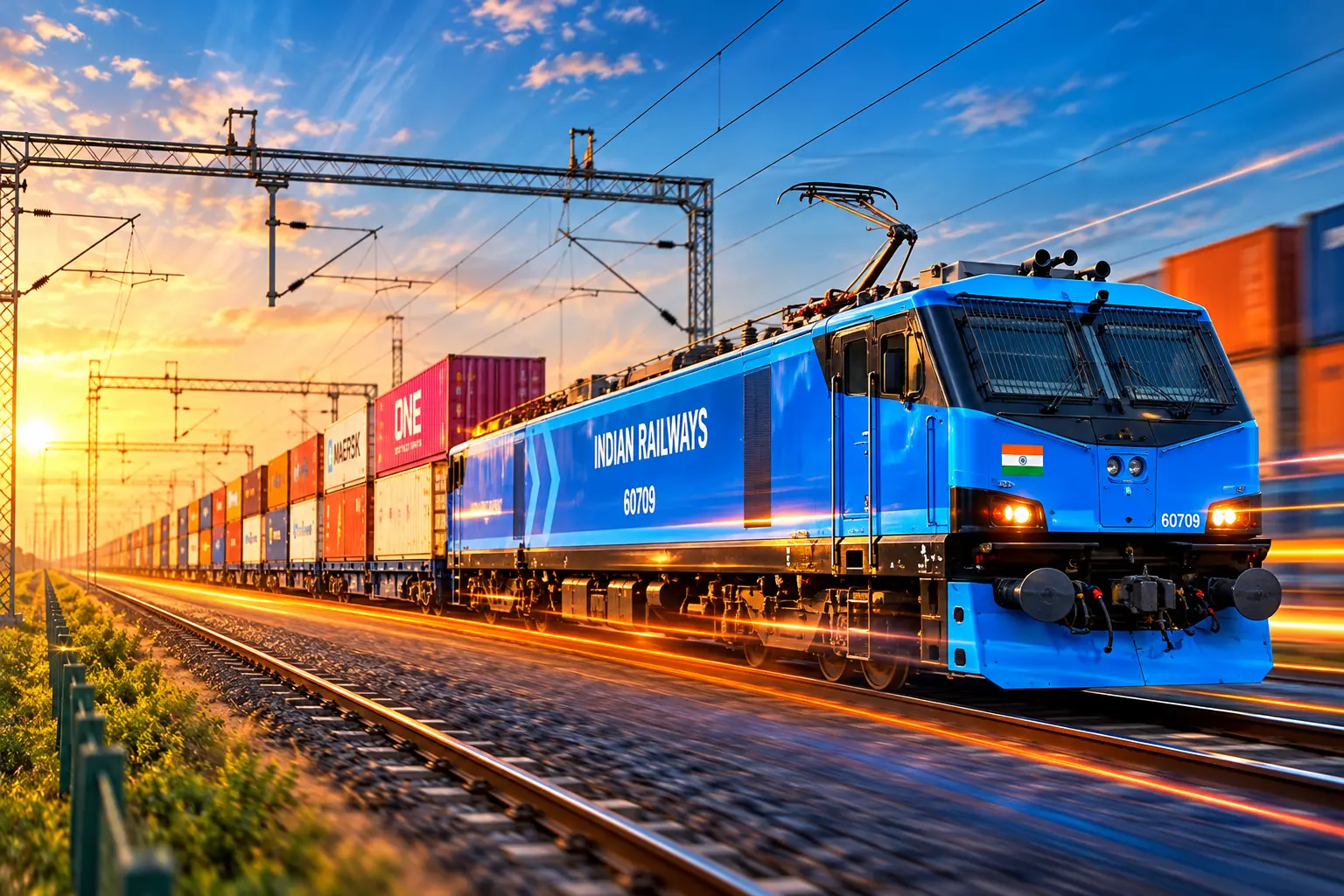
The western line was built for double-stack containers under electric wires, which is the feature Indian Railways calls unique at corridor scale. Contact wires sit about 7.45 metres above rail, high enough for two boxes and a special pantograph. American double-stack trains usually run on diesel because ordinary catenary would hit the upper box. WAG-12B locomotives from Madhepura, rated at 12,000 horsepower, are meant to haul about 6,000 tonnes at up to 120 kmph. The corridor itself is built for freight at up to 100 kmph, against a historic commercial average near 25 kmph on mixed tracks. Bridges are designed for 32.5 tonne axle loads, with 25 tonnes on the rails to start.
That design was already in motion before the Vadodara stage. On August 22, Railway Minister Ashwini Vaishnaw posted the first long-haul double-stack container train on the western corridor, a 1.3 km formation from JNPT to Vadodara, close to the 1,500 m train length the line was drawn for.
📢 First Long Haul (1.3 km) Double Stack container train on Western Dedicated Freight Corridor
JNPT, Mumbai -> Vadodara, Gujarat pic.twitter.com/CY9kWabvrM
— Ashwini Vaishnaw (@AshwiniVaishnaw) August 22, 2026
Every wagon that actually leaves the harbour that way is one less trailer on the approach roads. Maharashtra Chief Minister Devendra Fadnavis, speaking at Uran the same day as the Vadodara event, put a round number on the bet and a China comparison that is his, not a measured national series.
India’s logistics cost was around 14 per cent, while it was 7 per cent in China. Prime Minister Narendra Modi had brought it down from 14 to 10 per cent. But with this Dedicated Freight Corridor, we will bring it down to 7 per cent. We will be able to compete with China and become a part of the global supply chain.
Devendra Fadnavis, Chief Minister of Maharashtra, at Uran
He also said one double-stack train can carry the load of 250 trucks, and that a road haul of about three days can fall to about 12 hours on the corridor. He thanked JICA and the Japanese government. Those are political targets. The port’s own rail share is the number that will show whether they land.
Roads, Houses and a Line Into Alirajpur
Vadodara still received a local bundle, because that is how these days are built. Patel pointed to Gati Shakti Vishwavidyalaya and the C-295 aircraft plant as proof the city sits on a wider industrial map. A new passenger train between Tanda Road and Vadodara’s Pratapnagar station was flagged off. The Jobat-Tanda Road line, part of the Chhota Udepur-Dhar project, was dedicated to connect tribal pockets of Alirajpur to the national network.
WORKS AROUND THE FREIGHT SPINE
- Extra main-line capacity: Third and fourth lines between Vadodara and Ratlam, plus Vishwamitri-Dabhoi doubling, are meant to unclog passenger and goods paths into Madhya Pradesh.
- Gauge conversion: Miyagam Karjan-Choranda-Malsar is to be converted so branch traffic can join the broad-gauge grid.
- NH-48 and NH-53: Six-laning on Kamrej-Chalthan, extra bridges over the Tapi and Narmada on the Vadodara-Surat run, and grade separators at Abhava, Mindhola and Khajod, with six-lane flyovers at Kandari Chokdi and Luvara Patia already opened.
- City and water: Vadodara Urban Development Authority Ring Road Phase II, a new municipal office, PMAY housing, and a water scheme for 11 villages in eastern Vadodara.
- Power on water: A 110 MW floating solar project at Kadana Dam.
Patel said more than 16.53 lakh houses had been given under the Pradhan Mantri Awas Yojana in urban and rural Gujarat, and that Nal Se Jal had extended tap water. He said 20 lakh saplings were distributed around the visit. Those figures belong to state welfare programmes, not to the freight clock.
The Shift From Trailers Has to Happen at the Gates
Feeder links already tie, or are meant to tie, the western corridor to Mundra, Kandla, Pipavav and Hazira, so Gujarat ports have not been waiting on Vadodara to put a single box on a DFC wagon. JNPA was the missing harbour. DFCCIL managing director Praveen Kumar said in 2025 that the two corridors already moved over 13% of the country’s railway freight on about 4% of the network, with only the last western kilometres still to come. That concentration is the point of a freight-only pair: pull heavy trains off the Delhi-Mumbai and Delhi-Howrah passenger routes, then sell the spare paths as more trains for people.
The Centre has also floated a 2,052 km Dankuni-Surat freight corridor, with a detailed project report still being written, and talked of east-coast and north-south freight lines that are not yet sanctioned. Those maps are future paper. The live constraint is older and shorter: yard space, trailer drivers, CFS clusters, and how many rakes JNPA can actually build and accept now that the main line is open.
Double-stack trains from New JNPT will not clear a gate if the boxes never reach the siding. Rail’s share of JNPA traffic fell even as rakes got heavier, which means the corridor can add tonnes per train and still lose the port’s growth to the highway. The 326 km dedicated on September 8 close a file opened in 2005. They do not, on opening day, rewrite the 14.1%.
Frequently Asked Questions
What Is the Western Dedicated Freight Corridor?
It is a 1,506 km freight-only electrified railway from Dadri in Uttar Pradesh to JNPT near Mumbai, built for double-stack containers, with its own stations so goods trains do not wait behind passenger services. Indian Railways has said the two dedicated corridors were meant to take about 70% of goods trains off the mixed network.
When Was the Dedicated Freight Corridor Project Approved?
The idea entered a mid-term review of the Tenth Five-Year Plan and was formally proposed in April 2005; DFCCIL was incorporated on October 30, 2006, and the Cabinet Committee on Economic Affairs approved both corridors in February 2008. Japan later funded the western line after a 2009 loan clearance.
How Does Double-Stack Operation Work on the Western Dedicated Freight Corridor?
Two containers sit one above the other on flat wagons under contact wires about 7.45 metres above the rail, using high-reach pantographs on electric locomotives. DFCCIL’s own planning notes said double-stack on flats can raise throughput per train far more than well-type wagons, which is why the western line was drawn that way while the eastern line stays single-stack for coal, steel and grain.
Which Western Dedicated Freight Corridor Sections Were Dedicated in Vadodara?
New Sanand (North)-New Makarpura, New Umbergaon-New Saphale and New Saphale-New JNPT, together 326 km. A 538 km eastern extension from Sonnagar to Dankuni was earlier removed from the DFC project and is being handled separately, so the 2,843 km now called complete excludes that leg.
How Much of JNPA Container Traffic Moves by Rail?
In 2025-26 the port recorded 1,152,381 TEUs on inland rail, which is 14.1% of 8.17 million TEUs handled. Average berth stay was 1.02 days and overall turnaround (port account) was 1.71 days, which shows the berths are not the main delay; the landside move still is.
The western corridor now has a continuous dedicated path to JNPA, and the August double-stack run showed the wires will take a 1.3 km train. Until the port puts a much larger share of 8.17 million TEUs on those rails, the last 326 km will remain a finished line waiting on the gates.

Brain-IT Rebuilds Seen Images After One Hour of Scans

Middle East Oil Tops Pre-War Marks by Skipping Hormuz

Peacock’s Fast Series Shares 2028 With Fast Forever

NASA and IBM’s Lunar Model Cuts Polar Ice-Map Error

SteelSeries Sells Infinite 8K Mice That Still Need a Dock

Micron’s $22 Billion Deposits Cover Only a Fifth of DRAM

OnePlus 16 Bets on 200MP and a Familiar 3x Sony

C Spire Plans a 200-Mile Fiber Line for One Customer

Gag Reflex Removal Surgery Cost – Exploring Treatment Expenses for Gag Reflex Management

How to Change Background Color in Epic Hyperspace – Personalizing Your EHR Interface
-
 BUSINESS2 months ago
Micron’s $22 Billion Deposits Cover Only a Fifth of DRAM
-
 NEWS2 months ago
OnePlus 16 Bets on 200MP and a Familiar 3x Sony
-
 NEWS2 months ago
C Spire Plans a 200-Mile Fiber Line for One Customer
-
 LIFESTYLE3 years ago
Gag Reflex Removal Surgery Cost – Exploring Treatment Expenses for Gag Reflex Management
-
 TECHNOLOGY3 years ago
How to Change Background Color in Epic Hyperspace – Personalizing Your EHR Interface
-

 LIFESTYLE3 years ago
Types of Alligators in Florida – Discovering Reptilian Diversity in the Sunshine State
-

 NEWS2 months ago
The AI Boom Arrived and Workers’ Share Hit a Record Low
-

 NEWS2 months ago
Debian Puts Generative AI Risk on Volunteer Submitters