
BUSINESS
State AGs and Banks Trap the CLARITY Act Vote
Senate Democrats sent a CLARITY Act counteroffer on ethics and AG power hours before a 60-vote cloture test that banks and state prosecutors still contest.

Senate Democrats sent Republicans a late CLARITY Act counteroffer on September 14, hours before a 60-vote cloture test. The vote is set for 2:15 p.m. Eastern Time on September 15 on the motion to proceed to H.R. 3633, the Digital Asset Market Clarity Act.
Senator Ruben Gallego of Arizona, a lead Democratic negotiator, has been driving the ethics rewrite after a meeting with Senate Minority Leader Chuck Schumer. The token rules are largely drafted. State prosecutors who bring crypto fraud cases, and banks that fear stablecoin rewards, now set the price of those 60 votes.
Gallego’s Counteroffer Lands on the Eve of Cloture
People familiar with the talks said Democrats transmitted the counteroffer late on September 14, after Republican sponsors had already called their Sunday draft the last offer. CoinDesk could not confirm the line-by-line text, only that it went across. The chief Democratic complaint, including from senators who might still vote yes, is that the new ethics language still blocks state attorneys general from suing the president directly, and that the Office of Government Ethics could issue a notice letting senior officials keep crypto business ties.
Senate Banking Digital Assets Subcommittee Chair Cynthia Lummis of Wyoming, Agriculture Committee Chairman John Boozman of Arkansas, and Banking Chairman Tim Scott of South Carolina released that Sunday substitute with 126 substantive changes requested by Democrats over more than a year of talks. If cloture is invoked, they plan to offer it as an amendment in the nature of a substitute. A senior Republican aide said the ethics title covers roughly 80 percent of the July counterproposal Gallego wrote with Senator Thom Tillis of North Carolina.
Lummis has closed the bargaining window in public. “After a year of intense daily bipartisan negotiations, this bill is ready,” she said in the sponsors’ release. “Democrats got what they wanted; now they need to take yes for an answer.”
After a year of intense daily bipartisan negotiations, this bill is ready. Here is the final text. President Trump voluntarily agreed to new ethics provisions holding every federally elected official, judge, and their spouses to some of the toughest ethics restrictions in U.S.…
— Senator Cynthia Lummis (@SenLummis) September 14, 2026
Patrick Witt, a White House crypto adviser, told a Washington audience on September 14 that Republicans had already gone to great lengths. “If there are any changes, we’re talking about punctuation at this point,” Witt said. He added that floor votes belong to senators, not to him.
Senator Kirsten Gillibrand of New York has been urging colleagues to advance the bill even with doubts about the final text. Senator Elizabeth Warren of Massachusetts, the ranking Democrat on Senate Banking, has been pushing the other way, arguing that Justice Department enforcement would still need a White House green light.
Eighteen Attorneys General Draw a Hard Line on Fraud Cases
The ethics title is only half of the state fight. On September 14, New York Attorney General Letitia James led a bipartisan coalition of 17 other attorneys general in a letter to Scott and Warren urging the Senate not to pass the CLARITY Act as written. They warn it would make it harder for states to bring crypto scam cases and would let the Securities and Exchange Commission preempt state registration authority, a grant they say could reach beyond digital assets.
As written, the Clarity Act would embolden scammers and potentially strip attorneys general of our authority to protect our states’ investors and their wallets. Together with my attorney general colleagues, I urge Congress not to pass the Clarity Act.
Letitia James, New York attorney general, September 14 statement
Kansas and Ohio signed with California, Arizona, and New York. That is not a Democratic mailing list. The letter’s core ask is police power over scams, not a cameo in a White House ethics clause.
THE FRAUD NUMBERS THE AGS CITED
- FBI losses: The bureau logged $11.4 billion in cryptocurrency-related complaints in 2025, up 22 percent from 2024, with an average reported loss of $62,604.
- FTC losses: The commission logged $1.78 billion in cryptocurrency complaints in 2025, a 25.6 percent increase from 2024.
- State cases: States have brought more than 330 anti-fraud actions in the crypto market since 2017, often where victims had no federal case.
- New York: Complaints to James’s office about crypto scams have tripled over three years, and reported losses totaled nearly half a billion dollars over five years.
James’s office points to its own docket, from Tether and Bitfinex through Gemini, Genesis, KuCoin, and a $200 million Luna-related settlement with Galaxy Digital. The attorneys general want the bill to keep state enforcement for tokenized and non-tokenized securities, keep federal-state cooperation, preserve state registration of platforms, and clean up language they say defendants will use to stall cases.
That preemption fight is separate from the ethics argument, and it travels with Republican as well as Democratic prosecutors. A senator who votes yes on cloture is voting into both fights at once.
Why the Ethics Language Still Falls Short for Democrats
Sponsors say President Donald Trump agreed to limits they call among the toughest ever applied to federal officials, judges, and their spouses. Covered officials would have to divest “substantial” or “significant” crypto interests or place them in a qualified blind trust. State attorneys general would get an enforcement role the White House had resisted through the summer.
Financial disclosures released in late June show more than $1 billion in crypto-related income for Trump in 2025. That figure is why Democrats treated ethics as a gate, not a side car. In June, talks among Gillibrand, Gallego, Lummis, Senator Bernie Moreno of Ohio, and Witt broke down after Republicans pulled a mechanism that would have let state attorneys general sue the Justice Department for failing to enforce the rules.
WHAT WE KNOW
- The Sunday bargain: Trump signed off on divest-or-blind-trust language and a state AG role after meeting advisers on September 12.
- The Tillis-Gallego share: A senior Republican aide put the new ethics title at roughly 80 percent of the July bipartisan draft.
- The remaining gap: Democratic negotiators say AGs still cannot bring a direct action against the president, and the Office of Government Ethics could bless continued crypto ties.
WHAT IS UNCONFIRMED
- The Monday paper: The full Democratic counteroffer had not been released publicly as of the morning of September 15.
- Waiver mechanics: How an OGE notice would work for a sitting president, and whether family-controlled entities are covered, is still argued from drafts rather than a public statutory read.
Warren’s staff has told Democratic offices that AG power on the ethics title is thinner than it looks, because the Justice Department would still hold the real case and is unlikely to move without the White House. That is the same independence problem that collapsed the June session. Gallego’s paper is an attempt to close it in hours, not months.
Banks Say the Circuit Breaker Fires After the Damage
A second outside bloc is moving Republican votes. Eight banking trade groups, including the American Bankers Association, the Bank Policy Institute, and the Independent Community Bankers of America, wrote Majority Leader John Thune and Schumer on September 14. They support a federal crypto rulebook in principle. They do not support the yield and rewards text in the Sunday draft.
The bill tries to bar yield, or incentives that act like yield, on payment-stablecoin balances, while allowing rewards tied to transactions. The groups say that line is easy to walk around through rewards calculated off balance, duration, or tenure. On September 10, all 77 state bankers associations, joined by the ABA and ICBA, had already asked the Senate to tighten Section 10404 on that point.
Sunday’s draft also gives Treasury Secretary Scott Bessent new power to step in if payment stablecoins pull deposits from community banks. Sponsors call it a circuit breaker for those banks, and for the farmers and small businesses that borrow from them. The trades call it an admission of the risk and a tool that fires too late. They wrote that a circuit breaker that activates only after substantial deposit flight is not a safeguard at all.
STABLECOIN YIELD, TWO READS OF THE SAME DRAFT
| Issue | Sunday substitute | Bank groups’ ask |
|---|---|---|
| Payment-stablecoin yield | Bars yield-like payments on balances; allows transaction rewards | Close balance, duration, and tenure reward paths so tokens cannot act like deposits |
| Deposit-flight tool | Treasury may intervene if community banks lose deposits at scale | Prohibit interest-like rewards up front, rather than after outflows |
| Who feels it first | Sponsors cite community banks, farmers, and rural lenders | Same lenders, plus any bank that funds local credit from deposits |
Witt has called the deposit-flight claim overstated. Banks are not arguing theory to their senators. They are arguing loan books. That is why this fight shows up in Republican offices as well as Democratic ones.
Collins, Cornyn and the Bank-Aligned Holdouts
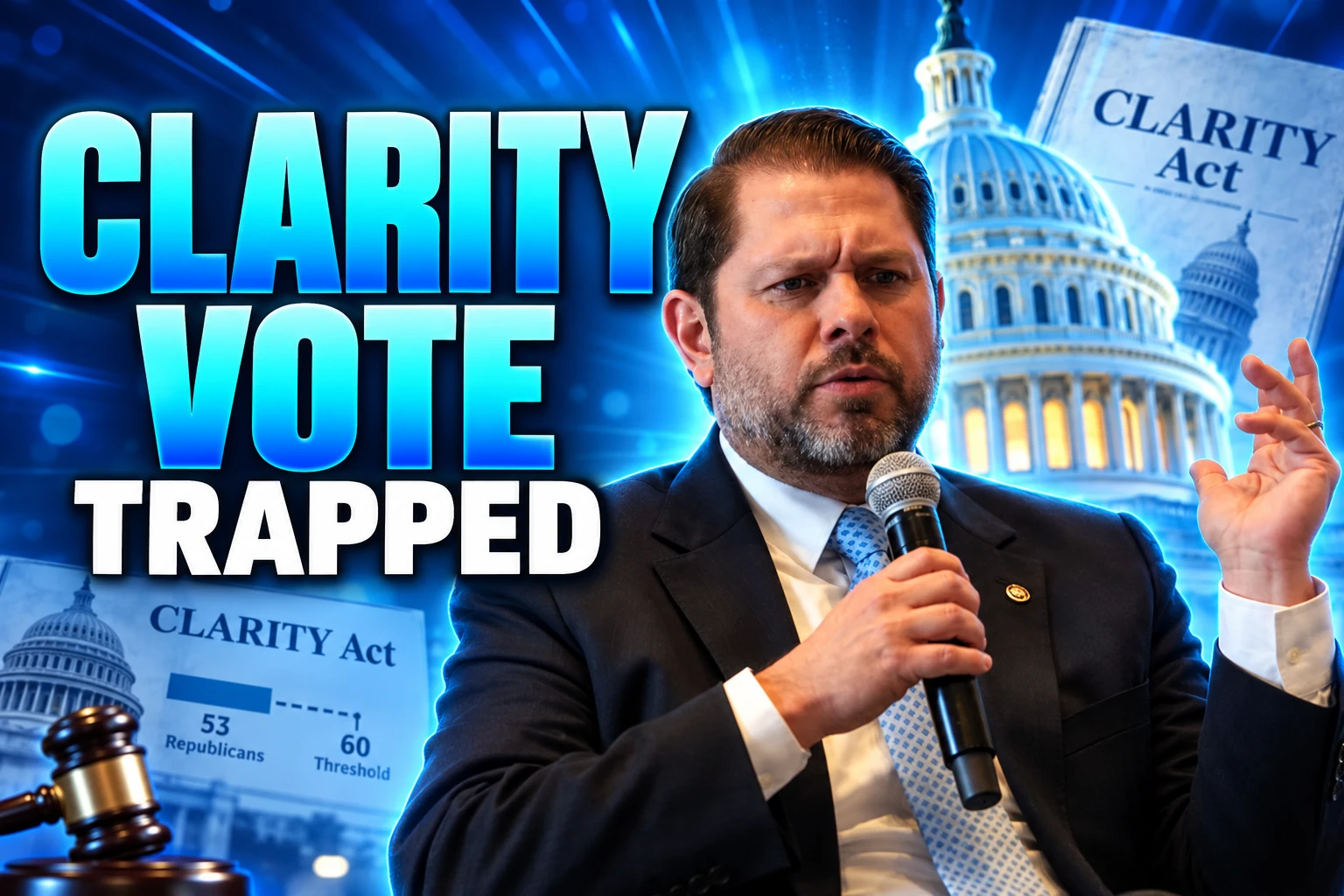
Republicans hold 53 Senate seats. Cloture needs 60. If the GOP conference holds, sponsors still need at least seven Democratic or independent votes. Final passage after debate would need only a majority. Cloture is the gate that can shut the rest of the calendar.
THE 60-VOTE PIECES STILL LOOSE
- Democratic yeses: Gallego and Senator Angela Alsobrooks of Maryland have treated ethics as a condition, not a preference, which is why the Monday counteroffer exists.
- Democratic nos: Warren is organizing against the ethics design. Other Democrats have not posted a public whip count.
- Republican doubt: Senator John Cornyn of Texas told reporters on September 14 he was still considering his vote, citing law enforcement groups and banks, and asking for an update on the latest text. Senator Susan Collins of Maine has raised the same deposit-flight worry from banking groups.
- The math if they bolt: If Collins and Cornyn both vote no, Republicans would need nine Democratic votes, not seven, to reach 60.
Gillibrand can peel off some of her caucus. She cannot peel off Kansas’s attorney general, and she cannot rewrite Section 10404 from the floor in a single afternoon. Cornyn’s hesitation is the bank letter in a Senate microphone. Treat the vote as a party split and you miss why two Republicans are even pausing.
What the Clarity Act Would Change if Debate Opens
H.R. 3633, sponsored in the House by Representative French Hill of Arkansas, would split digital-asset oversight. The Commodity Futures Trading Commission would take digital commodities on mature blockchains. The SEC would keep investment-contract tokens. Exchanges, brokers, and dealers would face new registration, custody, and conflict rules. The House passed the House 294 to 134 on July 17, 2025, with 78 Democrats in the yes column.
The Sunday Senate substitute also narrows the Blockchain Regulatory Certainty Act so its developer safe harbor covers Bank Secrecy Act civil enforcement, not criminal cases under the unlicensed money-transmitting statute. Prosecutors’ groups had warned that a broader shield would get in the way of active investigations. The agriculture title adds limits on affiliate trading and vertical integration among digital-commodity exchanges, brokers, and dealers, and states that state consumer-protection laws still apply.
THE PATH TO THE 2:15 P.M. VOTE
- July 17, 2025: The House passes H.R. 3633, 294-134.
- May 14, 2026: The Senate Banking Committee advances a companion 15-9, with Gallego and Alsobrooks among the Democratic yeses.
- August 8, 2026: Thune files cloture on the motion to proceed, locking a vote after the summer recess.
- September 14, 2026: Sponsors drop the substitute; James sends the AG letter; bank trades send the circuit-breaker letter; Democrats send a counteroffer that night.
- September 15, 2026: Cloture is scheduled for 2:15 p.m. Eastern Time.
If the motion succeeds, debate can run and the substitute can be offered. The bill would still need a passage vote, then House agreement on whatever the Senate changed. House leaders have already canceled the weeks of September 21 and September 28. The Senate’s next state work period begins October 5. Election Day is November 3.
Lummis Warns the Window Closes With This Vote
Lummis has told colleagues a no on September 15 means opposing ethics limits on politicians’ own holdings, handing digital-asset leadership to other countries, and leaving U.S. customers with no federal market rules. She has also said that missing this Congress could push a market-structure law toward 2030. Scott, in the same release, said the final text “further empowers law enforcement and gives the Treasury Secretary the tools to protect community banks, farmers, and rural Americans.”
Alesia Haas, Coinbase’s chief financial officer, sketched a different map if the Senate stalls. “There was always three paths to getting Clarity,” she said at a Goldman Sachs conference on September 11. “There was Congress, there were the agencies themselves, or there was the court system.” She said SEC Chair Paul Atkins and CFTC Chair Selig have already been moving on agency rules, and that a legislative miss would not, in her view, force the firm to shrink its product plans.
That fallback is cold comfort to the people actually whipping the floor. State attorneys general want language that keeps their scam docket intact. Banks want yield-like rewards killed before deposits move, not a Treasury switch after they have moved. Gallego’s counteroffer tries to buy Democratic votes on the first problem. It does not answer Cornyn on the second. The 2:15 p.m. roll call will show which of those outside parties had the votes, and which had only the letters.
Disclaimer: This article is news reporting on pending United States legislation and related public statements. It is for information only and is not investment advice, legal advice, or a recommendation to buy, sell, or hold any digital asset, security, or bank product. Readers who may be affected by market-structure rules, stablecoin rewards, or enforcement changes should consult a licensed attorney or a qualified financial adviser about their own facts. Vote schedules, bill text, and the status of negotiations can change after the sources cited here.

Russia Squeezes Ukraine’s Internet From Kyiv to Poland

State AGs and Banks Trap the CLARITY Act Vote

Apple Turns the Old Siri Opt-In Into Model Training

Google Maps Keeps the Speedometer On Without a Route

Serverpod’s App Studio Turns Vibe Code Into a Real Stack

OnePlus 16 Bets on 200MP and a Familiar 3x Sony

Micron’s $22 Billion Deposits Cover Only a Fifth of DRAM

CNG and Hybrids Push Alternative Fuels Past Petrol

C Spire Plans a 200-Mile Fiber Line for One Customer

The AI Boom Arrived and Workers’ Share Hit a Record Low
-
 NEWS1 month ago
OnePlus 16 Bets on 200MP and a Familiar 3x Sony
-
 BUSINESS1 month ago
Micron’s $22 Billion Deposits Cover Only a Fifth of DRAM
-
 AUTO3 weeks ago
CNG and Hybrids Push Alternative Fuels Past Petrol
-
 NEWS3 weeks ago
C Spire Plans a 200-Mile Fiber Line for One Customer
-

 NEWS1 month ago
Debian Puts Generative AI Risk on Volunteer Submitters
-

 TECHNOLOGY2 years ago
How to Change Background Color in Epic Hyperspace – Personalizing Your EHR Interface
-
 NEWS4 weeks ago
The AI Boom Arrived and Workers’ Share Hit a Record Low
-

 LIFESTYLE3 years ago
Types of Alligators in Florida – Discovering Reptilian Diversity in the Sunshine State