
BUSINESS
India Condemns El Gaia Attack as One Seafarer Stays Missing
A Panama-flagged tanker with 14 Indian crew was hit off Oman. Thirteen are ashore, one is missing, and Hormuz ministers meet the next day.

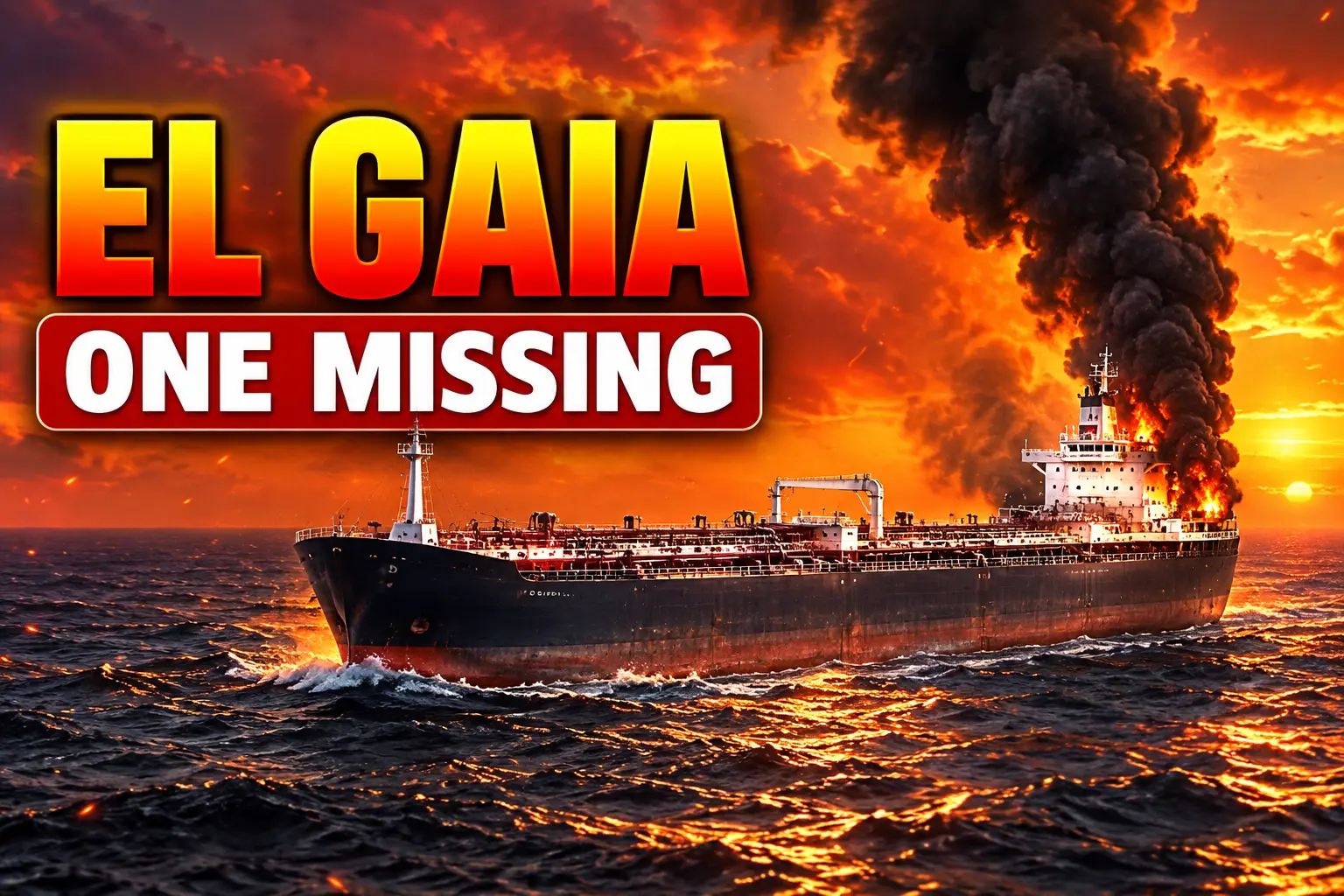
India said 13 of 14 Indian crew members on the tanker El Gaia were rescued after an attack off Oman, with one seafarer still missing. The Ministry of External Affairs condemned the strike on 13 September and called the targeting of commercial shipping, seafarers and civilian sites unacceptable.
The ship does not fly India’s flag. It is a Panama tanker run from Dubai, and the people on deck were Indian. That is the exposure New Delhi keeps inheriting in the Strait of Hormuz, where ministers meet on 14 September to talk about new shipping lanes, not about who staffs the boats.
The Projectile Hit a Panama Tanker Headed for Sohar
UK Maritime Trade Operations logged the strike as Warning 134-26 after a report at 2300 UTC on 12 September. A vessel transiting the strait had been hit by an unknown projectile. The agency classed the event as an attack and said the state of the crew, the damage and any pollution were not then known.
Maritime security firm Vanguard Tech later described a Panama-flagged tanker that sent a distress call, with a fire on board and the Omani Navy moving to take the crew off. India’s embassy in Muscat named the ship as El Gaia and said 13 Indians had been shifted ashore, with Omani search teams still looking for one missing crewman.
The Mission is closely monitoring the Search and Rescue (SAR) operations for the 14 Indian nationals on board the Panama-flagged tanker El Gaia.
SAR operations for 13 Indian nationals have been completed, and they have been shifted ashore safely. The Omani authorities are…
— India in Oman (Embassy of India, Muscat) (@Indemb_Muscat) September 13, 2026
AIS files list El Gaia as a Panama-flagged oil products tanker, IMO 9325336, built in 2005 at Imabari in Japan. Deadweight is 47,999 tonnes. Length is 179 metres. The registered owner is El Gaia Shipping Inc. The ISM and commercial manager is Elsey Ship Management LLC in Dubai. The last recorded destination was Sohar in Oman. Screening against major sanctions lists showed no hit.
EL GAIA AT THE TIME OF THE STRIKE
| Item | Detail |
|---|---|
| Flag | Panama |
| Type | Oil products tanker |
| IMO / MMSI | 9325336 / 371394000 |
| Deadweight | 47,999 tonnes |
| Length / beam | 179 m / 32 m |
| Gross tonnage | 28,799 |
| Built | 2005, Imabari, Japan |
| Manager | Elsey Ship Management LLC, Dubai |
| Recorded destination | Sohar, Oman |
The ministry did not name who fired and did not describe the weapon. A relative of the missing crewman appealed publicly to External Affairs Minister S. Jaishankar and the Muscat embassy to keep the search going. That appeal, not a debate about Hormuz map lines, is what the first hours of this story sounded like.
WHAT WE KNOW
- The ship: El Gaia is a Panama products tanker managed from Dubai, not an Indian-flag vessel.
- The crew: Fourteen Indians were on board; 13 are ashore; one remains missing.
- The strike: UKMTO recorded an unknown projectile at 2300 UTC on 12 September, and a fire was reported on a Panama tanker off Oman.
WHAT IS UNCONFIRMED
- The attacker: No government has publicly named who launched the projectile.
- The missing man: His condition has not been confirmed by the ministry or the embassy.
- A second ship: Iranian state media described a separate cargo-vessel hit off Qeshm Island, with one person killed and four injured, which is a different location from the Oman-coast rescue.
Qeshm’s governor blamed a “terrorist enemy” for that second strike. UKMTO had also spoken of a projectile hit in the strait, and it was not immediately clear in the first hours whether every report pointed at the same hull. India’s statement treated El Gaia as its own case: 14 Indian crew, 13 off, one still in the water.
Fourteen Indians Worked a Ship India Does Not Own
India is now the world’s second-largest supplier of seafarers after the Philippines, according to the BIMCO-ICS Seafarer Workforce Report 2026, released in June by the Baltic and International Maritime Council and the International Chamber of Shipping. The report counts 311,936 Indian seafarers, 12.16% of a global workforce of 2.57 million.
At officer level, the share is higher. India supplies 140,718 officers, 13.41% of the world’s officer workforce, and 171,218 ratings, 11.29% of global ratings. Those two counts add to the same 311,936 total. The Ministry of Ports, Shipping and Waterways has repeated the figures while pushing Mission 20%, a target to make one in five seafarers worldwide Indian.
INDIA’S SHARE OF THE WORLD’S CREWS
- Headcount: 311,936 Indian seafarers in the 2026 BIMCO-ICS count.
- Global share: 12.16% of 2.57 million seafarers, second after the Philippines.
- Officers: 140,718 people, 13.41% of the world’s officer workforce.
- The El Gaia bill: 14 Indians on a Panama hull, 13 rescued, 1 missing.
Indian-flag ships are a sliver of world tonnage. The people are not. Ratings and officers take jobs on Panama, Liberia and Marshall Islands hulls because the pay is in dollars and the ships are where the cargo is. El Gaia is that model in one file: a 21-year-old products tanker, a Dubai office, a Panama flag, and an Indian crew when the projectile hit.
Kirti Vardhan Singh, minister of state for external affairs, told the Rajya Sabha on 30 July that 10 Indian seafarers had been killed in West Asia since the conflict there began in 2026. El Gaia is not yet in that column. It is already in the other one, the list of Indian names that appear in Muscat rescue notes after someone else’s ship is struck.
We condemn the attack on the commercial vessel MT El Gaia off the coast of Oman earlier today. Of the 14 Indian crew onboard, 13 Indians have been rescued so far. Search and Rescue operations for the missing Indian national are continuing.
Ministry of External Affairs, New Delhi, 13 September 2026
The same statement thanked Omani authorities and said the embassy was working the search. It also repeated India’s line on lowering tensions, using talks, and restoring free movement through international waterways. The sentence about seafarers sat in the middle of that diplomatic paragraph, which is where Indian crews usually sit in these releases: named, counted, and then folded into a call aimed at governments that do not hire them.
Why Indian Crews Still Sign On for Hormuz Runs
They sign on because the jobs are there and the flag state is not India. A rating can earn about $2,000 a month; a master on a large ship can earn more than $12,000. Those figures are the labour market that filled El Gaia, not a policy paper in New Delhi. Hormuz is still a place those contracts send people, even after months of projectile warnings and fires.
Prime Minister Narendra Modi has proposed an emergency support network for seafarers in distress, and he put that idea to BRICS partners as attacks on sailors piled up. The Directorate General of Shipping already runs a round-the-clock centre and in early September launched e-Navik 24×7, a ticketed system for wage fights, abandonment, detention, death and missing-seafarer cases. That does not change the basic hire: foreign ship, Indian crew, Indian embassy when it goes wrong.
India has also tried to move oil away from a single chokepoint, and officials have said ships carrying oil, gas and fertiliser still reach Indian ports from more than one route. The seafarer problem does not move with the barrels. A products tanker bound for Sohar can carry a full Indian complement whether or not the cargo is headed for an Indian refinery. El Gaia’s file shows that split in clean form.
New Delhi Has Issued This Oman Statement Before
The 13 September text is close to language the ministry used after earlier hits off the same coast. On 10 June it condemned an earlier attack off the Oman coast on the commercial vessel Settebello. Of 24 Indian crew on board, 21 had been rescued and three were missing. The embassy line then was the same: watch the search, thank Muscat, demand that attacks on commercial shipping stop.
Two days after Settebello, the ministry summoned U.S. Chargé d’Affaires Jason Meeks. It protested continuing U.S. naval attacks on commercial vessels carrying Indian mariners in the Gulf of Oman, which it said had already caused the loss of three Indian lives. Lethal force against civilian shipping, it said, was unacceptable. That protest sat alongside the other ledger, the one in which Indian crew die on ships hit by other forces in the same water.
INDIAN CREWS IN THE SAME WATER, 2026
- 10 June 2026: MEA condemns an attack on Settebello off Oman; 21 of 24 Indian crew rescued, three missing.
- 12 June 2026: The U.S. chargé is summoned over naval attacks on commercial ships with Indian mariners; the ministry cites three Indian deaths.
- 30 July 2026: Kirti Vardhan Singh tells the Rajya Sabha that 10 Indian seafarers have been killed in West Asia since the conflict began.
- 8 to 10 September 2026: Maritime logs record a cluster of strikes in the Gulf of Oman and the strait, including U.S. action against Iranian tankers and a hit on Hercules Star that killed one crew member, with another injured and one missing.
- 12 September 2026, 2300 UTC: UKMTO Warning 134-26 records an unknown projectile on a vessel in the strait.
- 13 September 2026: The Muscat embassy and the MEA report 13 of 14 Indians off El Gaia, with one missing.
The ministry listed still another Oman-coast statement on 12 July. The pattern is the product. Indian mariners keep turning up in these notes because they are on the ships that keep moving, including ships that are not taking crude to Indian ports.
Manila Is Preparing a Ban India Has Not
The Philippines, the only country with a larger seafarer pool, has moved toward taking its people out of the strait. A draft advisory from its Department of Migrant Workers, circulating in the days before El Gaia, would bar owners and crewing agents from sending Filipino seafarers on vessels transiting Hormuz, after deaths and injuries of Filipino crew in the same fights.
India has not issued a matching bar. It has escorts for some Indian-flag tankers, advisories on security, and the new e-Navik channel. Mission 20% still points the other way: more Indians on more foreign ships, not fewer Indians in the one strait that is being used as a battlefield.
TWO LABOUR STATES, TWO ANSWERS
- Manila’s draft: Stop deploying Filipino crew on Hormuz transits after recent deaths and injuries.
- New Delhi’s tools: Embassy search teams, a 24×7 shipping centre, e-Navik tickets, and navy escorts for some Indian-flag tankers.
- The hire that remains: Foreign-flag ships can still take a full Indian complement through the strait, which is how 14 Indians were on El Gaia.
A ban is not free. It would cut earnings for ratings and officers who need the contracts, and it would squeeze owners already short of officers. The BIMCO-ICS report estimated a 2026 shortage of 39,100 certified officers. That shortage is why Indian papers still get signed on Panama tankers heading for Sohar. It is also why the next projectile, if there is one, is likely to find Indian names on the muster list again.
Hormuz Ministers Meet With the Waterway Still Shut
Foreign Minister Abbas Araghchi said the Oman meeting on 14 September would deal only with new maritime arrangements in the strait. Iran and Oman, he said, have agreed a new route, drawn the maps, and prepared a joint statement. Those papers are to be shown to the other governments in the room and then sent to the International Maritime Organization for registration.
The Iran-Oman agreement does not mean the reopening of the Strait of Hormuz. Rather, it sets out the framework and arrangements for maritime traffic should conditions for reopening the strait be met.
Abbas Araghchi, Iranian foreign minister, to Al-Araby Al-Jadeed
Reopening, Araghchi said, depends on the United States returning to the Islamabad memorandum of understanding. Iranian President Masoud Pezeshkian had already put the same condition in public, saying the waterway would open if the United States ended its blockade, and adding, “Our people can’t be bullied into submission. Iran won’t surrender.”
Bahrain said it would not attend, leaving a smaller table than the original eight Gulf-littoral plan. Araghchi described a session of Iran, its southern neighbours and Iraq, and he said the gathering was not a new regional security body and would not take up Yemen. For Indian crews the distinction is thin. A registered corridor still needs people on watch, and El Gaia’s missing man will not be helped by a map filed in London.
The MEA’s last ask on 13 September was that free and safe navigation and the flow of commerce through the region’s international waterways be restored at the earliest. Omani teams were still searching for one Indian national from a Panama tanker that had been heading for an Omani port. That search is the part of the Hormuz file India cannot hand to a joint statement.

Russia Squeezes Ukraine’s Internet From Kyiv to Poland

State AGs and Banks Trap the CLARITY Act Vote

Apple Turns the Old Siri Opt-In Into Model Training

Google Maps Keeps the Speedometer On Without a Route

Serverpod’s App Studio Turns Vibe Code Into a Real Stack

OnePlus 16 Bets on 200MP and a Familiar 3x Sony

Micron’s $22 Billion Deposits Cover Only a Fifth of DRAM

CNG and Hybrids Push Alternative Fuels Past Petrol

C Spire Plans a 200-Mile Fiber Line for One Customer

The AI Boom Arrived and Workers’ Share Hit a Record Low
-
 NEWS1 month ago
OnePlus 16 Bets on 200MP and a Familiar 3x Sony
-
 BUSINESS1 month ago
Micron’s $22 Billion Deposits Cover Only a Fifth of DRAM
-
 AUTO3 weeks ago
CNG and Hybrids Push Alternative Fuels Past Petrol
-
 NEWS3 weeks ago
C Spire Plans a 200-Mile Fiber Line for One Customer
-

 NEWS1 month ago
Debian Puts Generative AI Risk on Volunteer Submitters
-

 TECHNOLOGY2 years ago
How to Change Background Color in Epic Hyperspace – Personalizing Your EHR Interface
-
 NEWS4 weeks ago
The AI Boom Arrived and Workers’ Share Hit a Record Low
-

 LIFESTYLE3 years ago
Types of Alligators in Florida – Discovering Reptilian Diversity in the Sunshine State