
AUTO
BMW’s Electric i3 Undercuts Only Its Costliest Gas Twin
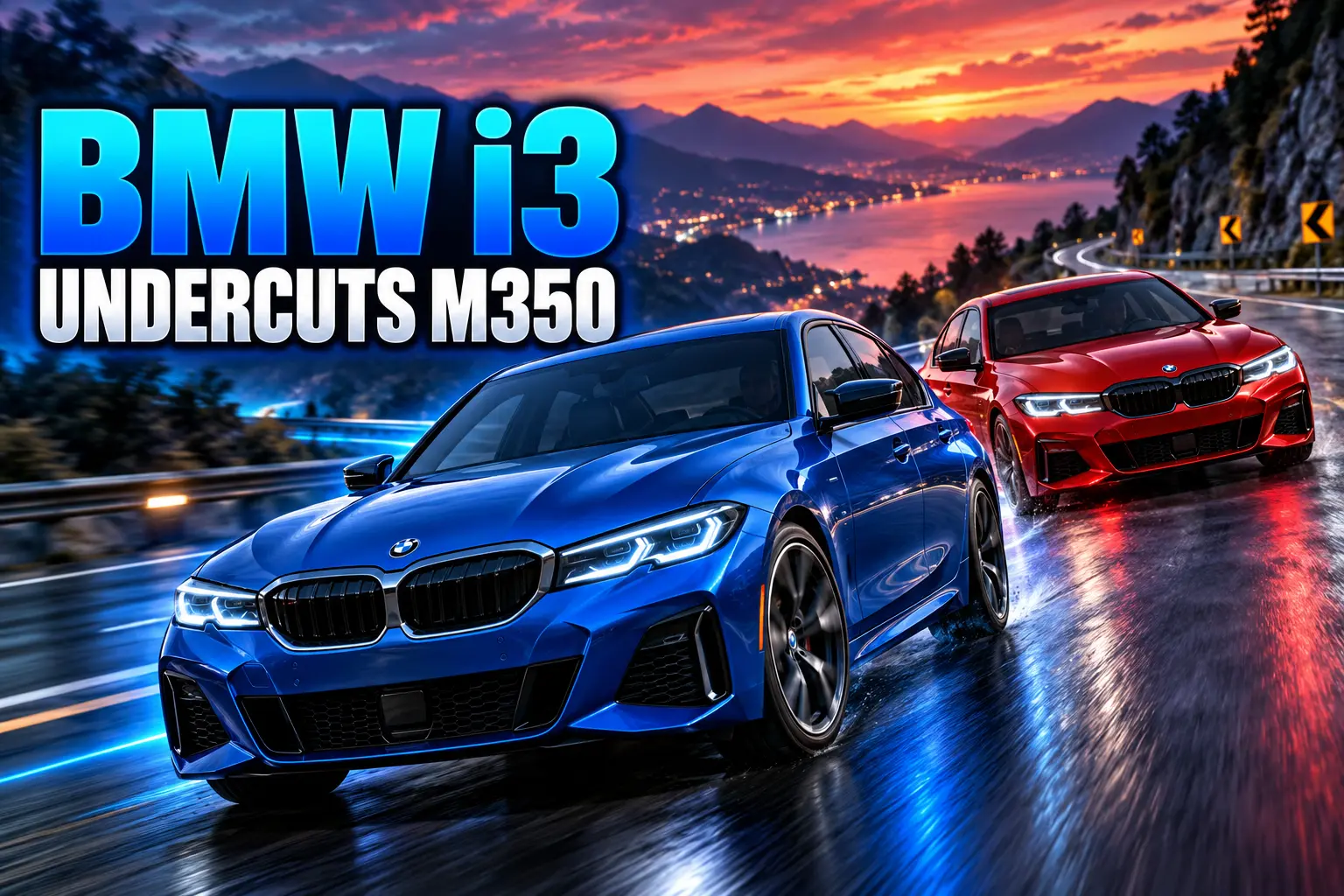
The 2027 BMW i3 50 xDrive undercuts the M350 by $4,400, yet the volume 330 remains $11,600 cheaper and Tesla’s AWD sedan starts lower still.

BMW priced its 2027 i3 50 xDrive at $61,500, $4,400 below the gas M350 xDrive and $11,600 above the four-cylinder 330. U.S. order books opened on September 29, 2026, with a $1,000 deposit, and showroom cars are due in the first quarter of 2027. Destination and handling add $1,350 to every trim, so the electric sedan lands at $62,850 before options.
The $4,400 gap is real, and it is also a matchup BMW chose. The car most 3 Series buyers still purchase is the 330, and that one never got an electric twin for launch.
BMW Priced the Electric Car Against Its Six
The i3 50 xDrive is a dual-motor all-wheel-drive sedan with 463 hp and 476 lb-ft, and BMW quotes 4.5 seconds from 0 to 60 mph. The M350 xDrive uses a 3.0-liter inline-six with 48-volt mild-hybrid assist, 437 hp, and 428 lb-ft. It reaches 60 mph in 3.9 seconds. On paper they sit in the same money band. The electric car’s sticker is 6.7% lower.
Both wear the new face, the wide cabin screen, and BMW Operating System X. Both are aimed at shoppers already comfortable north of $60,000. That is the comparison that produces a cheaper EV. It is also the comparison that ignores the rest of the garage.
The same $61,500 base is what BMW already asked for the iX3 50 xDrive, the first Neue Klasse model, when that SUV was priced on May 7, 2026. The electric 3 Series does not undercut its own crossover sibling. It undercuts the six-cylinder sedan that now sits at $65,900, or $67,250 with destination.
The 330 Still Undercuts the i3 by $11,600
The rear-drive 330 opens at $49,900. The 330 xDrive is $51,900. Those cars share a 2.0-liter turbo four with 48-volt assist, 255 hp, 295 lb-ft, and a 5.9-second run to 60 mph. Line them up with the electric launch car and the EV is the expensive 3 Series, not the cheap one.
2027 3 SERIES U.S. LAUNCH STICKERS
| Model | Powertrain | Horsepower | 0 to 60 | Base MSRP |
|---|---|---|---|---|
| 330 | 2.0L four, 48V | 255 | 5.9 sec | $49,900 |
| 330 xDrive | 2.0L four, 48V | 255 | 5.9 sec | $51,900 |
| i3 50 xDrive | Dual-motor electric | 463 | 4.5 sec | $61,500 |
| M350 xDrive | 3.0L six, 48V | 437 | 3.9 sec | $65,900 |
All four figures exclude the $1,350 destination charge. With that fee, the 330 is $51,250, the 330 xDrive is $53,250, the i3 50 xDrive is $62,850, and the M350 xDrive is $67,250. The $11,600 gap between the 330 and the i3 does not move. Against the 330 xDrive the electric premium shrinks to $9,600 and still points the other way.
Europe already sells a cheaper electric car BMW is not bringing to the United States at launch. The i3 40 xDrive starts at €59,900 in Germany and at £47,925 in the United Kingdom, where the petrol 320 opens at £44,975. The U.S. configurator, for now, has one electric sedan, and a loaded build has already been taken to $78,650 including destination after $15,800 in options.
Two Faces, Two Platforms, 791 Extra Pounds
The shared sheet metal hides different bones. The i3 sits on Neue Klasse, BMW’s new 800-volt electric platform, with a 114.1-inch wheelbase and a 49/51 weight split. The gas cars are G50 models on a reworked version of the outgoing CLAR architecture, with a 112.6-inch wheelbase. The electric car is 1.5 inches longer between the wheels and almost the same overall length.
BMW’s preliminary curb weight for the i3 50 xDrive is 4,960 pounds. The M350 xDrive is 4,169 pounds, so the EV carries an extra 791 pounds. The 330 is 3,827 pounds with a 52/48 split, and the 330 xDrive is 3,909 pounds. That mass is why the six-cylinder still wins the sprint even though it has 26 fewer horsepower.
WHERE THE CARS ACTUALLY DIVERGE
- The platform: The i3 is a clean-sheet Neue Klasse EV; the 330 and M350 keep a heavily revised CLAR chassis with engines from Steyr.
- The computer: The i3 gets BMW’s Heart of Joy driving computer; the petrol cars use an updated Driving Stack spread across older control units.
- The motors: Rear electrically excited synchronous motor at 322 hp and 321 lb-ft, front asynchronous motor at 165 hp and 188 lb-ft, combined to 463 hp.
- The factory: Munich builds the i3; Dingolfing will build the gas G50 from November 2026, the first time in the modern era the combustion 3 Series leaves Munich.
Sixth-generation eDrive, the same toolkit as the iX3, is the lever BMW is pulling on cost. In its U.S. iX3 pricing release, the company said the new drive hardware cuts energy losses by 40 percent, drive-unit weight by 10 percent, and manufacturing costs by 20 percent versus fifth-generation eDrive. That is how an electric 3 Series can show up under a six-cylinder sticker while sitting on the newer, more expensive-looking architecture.
How Far the i3 Goes on One Charge
BMW’s own testing, run to EPA procedures but not yet a finished EPA label, puts the i3 50 xDrive at 446 to 468 miles depending on wheels and tires. The company has not posted a 2027 tank figure for the gas cars. Earlier all-wheel-drive 3 Series models were good for about 450 miles a tank, which is why the range debate looks closer than EV shoppers are used to.
I3 50 XDRIVE CHARGE AND RANGE
- Range estimate: 446 to 468 miles on BMW’s EPA-procedure tests, still unofficial.
- Pack size: A 108.7 kWh high-voltage battery, with a WLTP range of up to 912 km on the same 50 xDrive hardware.
- DC peak: 400 kW on the 800-volt system, enough for an estimated 191 to 208 miles in 10 minutes.
- The plug: A native NACS port for Tesla Superchargers, plus bidirectional charging for vehicle-to-load at 3.7 kW and vehicle-to-home backup.
AC charging is listed at up to 15.4 kW in U.S. materials. Europe quotes 11 kW as standard and 22 kW as an option, with a 10-to-80 percent DC stop in 21 minutes. The electric car also gets a front trunk the gas sedan does not. For a driver who already thinks in 400-mile days, the remaining argument is the 10-minute stop versus a pump, not whether the i3 can do a highway week.
What Buyers Cross-Shop Instead of the M350
The intramural BMW math is tidy. The market math is not. Tesla lists its Model 3 Standard from $36,990, or $38,630 with destination and order fees. The Model 3 Premium Long Range AWD, the closer dual-motor match, starts at $47,490. That is $14,010 under the i3 50 xDrive before anyone talks options, insurance, or cargo.
The electric BMW answers with more peak power, an 800-volt pack, a much higher claimed range, and 400 kW charging. The Tesla answers with a lower sticker, a lighter car, and a lot of comfort gear already in the base price. Heated steering, three-zone climate, and a premium sound system are extra on the i3. Bidirectional charging, a proper driver display, and a 3D head-up display sit on the BMW side of that ledger. The comparison that keeps coming back is this one, not the $65,900 six.
Weight is the other complaint that will not stay in the comments. A nearly 5,000-pound compact sedan with a 108.7 kWh pack will use more energy to do the same road as a smaller-battery rival, even if the 800-volt hardware puts miles back quickly. BMW is selling range and charge speed. Tesla is selling a lower door price and a smaller pack. Those are different products that happen to compete for the same driveway.
The $99 Battery Pack and the U.S. Cost Gap
BloombergNEF’s 2025 survey put average lithium-ion pack prices of $108 per kWh, down 8% from 2024, with battery-electric vehicle packs at $99 per kWh. China averaged $84 per kWh. North American packs ran 44% higher than China’s, and Europe ran 56% higher. LFP packs averaged $81 per kWh; nickel-manganese-cobalt packs averaged $128.
Cut-throat competition is making batteries cheaper every year. This is an important moment for the industry, as record-low battery prices create an opportunity to lower EV costs and accelerate the deployment of grid-scale storage to support renewables integration around the world.
Evelina Stoikou, head of BloombergNEF’s battery technology team, 2025 Lithium-Ion Battery Price Survey
That cost drop is why a German sedan can even attempt this sticker. It is not why a U.S. shopper suddenly sees EV and gas as equal. BloombergNEF’s Electric Vehicle Outlook 2026 still put the U.S. powertrain cost premium around 25 percent for battery-electric hardware versus combustion, against about 10% in Europe and about 3% in China. The outlook also said price parity can show up before margin parity, which is another way of saying a carmaker can buy the headline.
BMW Group says it is putting about €2 billion ($2.27 billion) into German vehicle and battery production for this generation, including about €1 billion ($1.13 billion) at the Irlbach-Straßkirchen battery plant that begins supplying i3 packs in October 2026. The company can price the i3 under the M350 because it wants the new platform in the mix, not because the four-cylinder 3 Series suddenly became a charity case.
Munich Builds the EV, Dingolfing Keeps the Engine
Series production of the i3 started in Munich in August 2026. U.S.-spec cars were slated to follow on the same line in November. The gas G50 moves to Dingolfing from November 2026, sharing a hall with the 4, 5, and 7 Series. Munich is scheduled to go fully electric in 2027. The split is industrial as much as it is a product plan: one plant for the car BMW is pushing, one for the car it still needs to sell.
THE BUILD AND BUY CALENDAR
- September 30, 2025: The IRS New Clean Vehicle Credit is not available for vehicles acquired after Sept. 30, 2025, so a 2027 i3 will not clip $7,500 off the $61,500 base.
- August 2026: Munich starts series production of the i3 50 xDrive for Europe.
- September 29, 2026: BMW of North America opens U.S. reservations and the configurator, with a $1,000 deposit.
- November 2026: Dingolfing is due to start G50 petrol production, and U.S.-spec i3 builds were planned on the Munich line.
- First quarter of 2027: U.S. deliveries of the 330, 330 xDrive, M350 xDrive, and i3 50 xDrive.
The missing American car is the i3 40 xDrive, the smaller-battery dual-motor sedan Europe is already selling from €59,900 with an 82.8 kWh pack, 300 kW charging, and a 710 km WLTP rating. U.S. pricing for that trim has not been posted. Until it is, the electric 3 Series in this country is a $61,500, 4,960-pound, 468-mile estimate that beats BMW’s own six on sticker and loses to BMW’s own four by $11,600.
Parity arrived in the row of the window sticker where BMW needed a win. The 330 is still the cheaper 3 Series, Tesla still owns the cheaper electric sedan, and the first i3 that could trouble both of those facts has a name in Europe and no U.S. price.

SteelSeries Sells Infinite 8K Mice That Still Need a Dock

CBS and Tony Romo Part Ways After the Milwaukee Arrest

Word 2609 Still Hides PDFs After the SharePoint Fix

Sean Combs Lands in Solitary After Prison Perks Air

Congo Ebola Deaths Pass 4,018 Without a Licensed Vaccine

Micron’s $22 Billion Deposits Cover Only a Fifth of DRAM

OnePlus 16 Bets on 200MP and a Familiar 3x Sony

C Spire Plans a 200-Mile Fiber Line for One Customer

CNG and Hybrids Push Alternative Fuels Past Petrol

The AI Boom Arrived and Workers’ Share Hit a Record Low
-
 BUSINESS1 month ago
Micron’s $22 Billion Deposits Cover Only a Fifth of DRAM
-
 NEWS1 month ago
OnePlus 16 Bets on 200MP and a Familiar 3x Sony
-
 NEWS4 weeks ago
C Spire Plans a 200-Mile Fiber Line for One Customer
-
 AUTO4 weeks ago
CNG and Hybrids Push Alternative Fuels Past Petrol
-

 TECHNOLOGY2 years ago
How to Change Background Color in Epic Hyperspace – Personalizing Your EHR Interface
-
 NEWS4 weeks ago
The AI Boom Arrived and Workers’ Share Hit a Record Low
-

 LIFESTYLE3 years ago
Types of Alligators in Florida – Discovering Reptilian Diversity in the Sunshine State
-

 LIFESTYLE3 years ago
Do Jehovah Witness Go to Church on Saturday – Understanding Sabbath Practices in Jehovah’s Witness Faith