
NEWS
Mistral’s €3 Billion Round Leaves Europe’s Seed Pipeline Dry
Mistral’s €3 billion Series D took most of Europe’s €3.9 billion tech week as Seed-to-Series A conversion fell to 9.3%.

French AI lab Mistral closed a €3 billion Series D on September 8, the largest equity round ever by a European tech company. Samsung Electronics led at a post-money valuation of more than €21 billion (about $24 billion), with the EU-backed Scaleup Europe Fund and PSG Equity as co-leads.
Two days later, Antler told founders in London that Seed-to-Series A conversion in Europe had fallen to 9.3%. The same Thursday, campaigners said they had 100 days to stop Brussels watering down EU Inc, the planned pan-European company form.
A €3.9 Billion Week With Almost No Middle
Deal counters logged more than 70 European tech funding deals worth over €3.9 billion between September 8 and 10, plus more than five exits and related transactions. Mistral’s cheque was €3 billion of that pile, so the week’s headline total was one late-stage AI round with a long tail attached.
Growth capital still closed. Claret Capital Partners raised €575 million for a growth-debt fund aimed at European innovators, and Revolut backer Molten Ventures hit a £175 million first close on a growth fund. Positive, the French software group formerly called Sarbacane, completed a €106 million refinancing to buy other firms. The money is moving. It is moving toward companies that have already scaled, or toward buyers who tidy up the ones that have.
THE WEEK’S OUTSIZED CHEQUES
| Firm | Type | Amount | Date |
|---|---|---|---|
| Mistral AI | Series D | €3 billion | September 8, 2026 |
| The Exploration Company | Series C | $450 million | September 8, 2026 |
| Miro (Bending Spoons) | Acquisition | $1.355 billion EV | September 10, 2026 |
Those three events are not the same market as a €2 million Seed. They are the market that still has a queue of funds, corporates and public-backed growth vehicles. Everyone below that line is competing for a thinner book of active early-stage cheques.
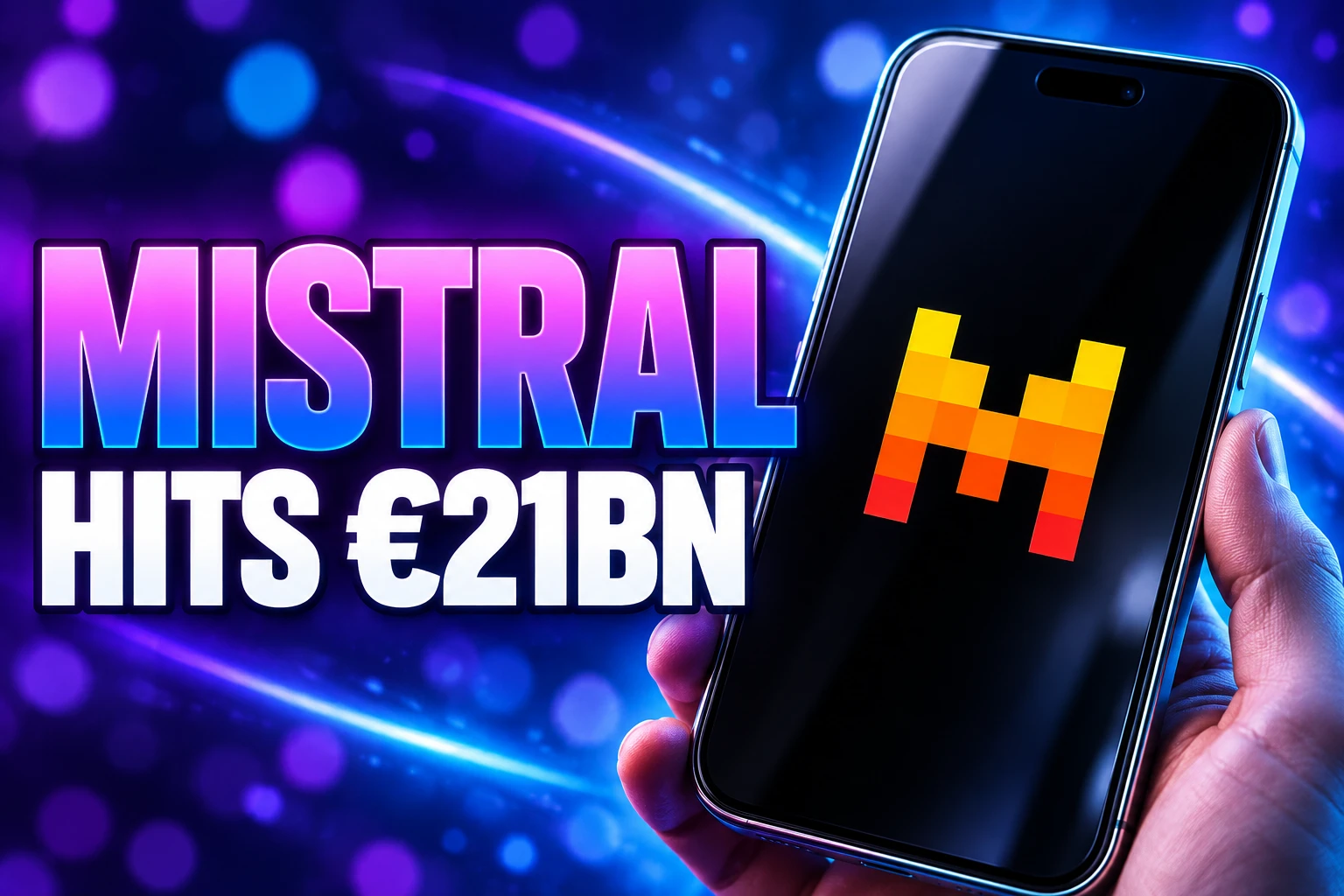
Mistral’s Record Round Lifted the Company Past €21 Billion
Paris-based Mistral, launched in 2023, said the Series D was the largest equity round by a European tech company. ASML had led a €1.7 billion Series C in September 2025, when the company was valued at €11.7 billion. The new mark is more than €21 billion, with new money from Advent, funds and accounts managed by BlackRock, and the Grand Duchy of Luxembourg.
Existing backers who came in again include a16z, ASML, Bpifrance, BNP Paribas CIB, Nvidia, Salesforce Ventures, General Catalyst, Index Ventures and Lightspeed. The cap table now reads like a supply chain. Samsung led. ASML is still there from the Series C. Nvidia participated again. Chipmakers and a lithography group are sitting on the same share register as the model lab, which is a manufacturing bet more than a chatbot bet.
Mistral said it will use the cash to expand frontier research, scale computing capacity for training, build out infrastructure, and push commercial growth. It now operates in 20 countries and says it supports more than 125 enterprises, including Airbus, ASML and HSBC. Chief financial officer Johan Bergqvist said the company is on track for $1 billion of annual recurring revenue by the end of 2026. The open-weight pitch is control: data kept inside the customer’s walls, models that can be customised, private compute, and production systems that stay auditable.
Today marks a major step for Mistral: we’re announcing a €3B Series D, the largest equity round ever raised by a European tech company, just three years after launch. pic.twitter.com/5AexUxyrZM
— Mistral AI (@MistralAI) September 8, 2026
The raise will be sold as Europe’s ChatGPT moment. That is the wrong product. The money is going into owned compute and enterprise deployments, not a cuter consumer assistant. French president Emmanuel Macron framed the Samsung cheque as France and South Korea building a third way in AI. The industrial reading is simpler. Whoever sells the chips and the scanners wants a lab that will buy them at scale and keep the models on European, Korean and customer-owned iron.
The Same EU Fund Backed the Space Raise Too
On the same day as Mistral’s announcement, The Exploration Company closed a $450 million Series C, which it called the largest-ever Series C by a European space company. Bessemer Venture Partners, Atomico and the Scaleup Europe Fund, managed by EQT, co-led. Balderton, Plural, Cherry and Red River West joined from the existing European book. Bessemer’s Alex Ferrara will join the board. Total funding is now about $680 million.
The Scaleup Europe Fund, which EQT is building toward a €5 billion target with public and private capital, therefore wrote cheques into both of Tuesday’s giants. That is the fund doing the job Brussels gave it: keep large European technology firms from having to raise their growth rounds only abroad. It is also a picture of where official Europe is willing to put sizeable equity. Seed funds do not get this call.
Founder and chief executive Hélène Huby, who spent two decades at Airbus and ArianeGroup, is using the round for two machines. Nyx is a reusable capsule meant to take cargo to stations and bring it home, with a first full orbital demonstration that includes docking with the International Space Station and a safe return, aimed at 2028. Storm is a reusable high-thrust engine burning liquid oxygen and biomethane on a full-flow staged-combustion cycle, meant for a future heavy launcher that could put up to 40 tons into low Earth orbit in reusable configuration.
This financing will allow us to execute with urgency: to bring Nyx to the International Space Station and safely back to Earth, while accelerating Storm, the high-thrust propulsion capability Europe needs for its future reusable heavy launcher.
Hélène Huby, Founder and CEO, The Exploration Company
TEC said it has won more than $2 billion in contracts and commitments, including work with the European Space Agency and a Space Act Agreement with NASA. It employs more than 550 people across Europe, the United States and the United Arab Emirates. Macron called it the largest Series C raised by a European space company. Commission president Ursula von der Leyen called it a strong moment for Europe’s space industry and pointed at the Scaleup Europe Fund’s role. Both political quotes landed on a company that already had contracts, engines on test, and a transatlantic board seat. That is the winner column.
Bending Spoons Buys Miro in a $1.355 Billion Cash Deal
The other large number on September 10 was an exit, not a round. Milan-listed Bending Spoons signed an all-cash deal at a $1.355 billion enterprise value for Miro, the collaboration workspace. Including Miro’s net cash, the implied equity value is about $1.79 billion. Some Miro shareholders agreed to put $295 million of proceeds into newly issued Bending Spoons shares. The close is aimed at the fourth quarter of 2026, subject to regulators. The boards approved the deal unanimously.
MIRO AT THE SIGNING
- Enterprise value: $1.355 billion in an all-cash transaction.
- Equity value: about $1.79 billion once net cash is counted.
- Reinvestment: $295 million of seller proceeds rolling into Bending Spoons stock.
- Revenue mix: about $600 million of annual recurring revenue, nearly 90% from business and enterprise customers, with more than 250,000 organisations on the product.
Bending Spoons completed its Airtable purchase on September 4. The Milan group’s method is now familiar: buy a known software brand that still throws off recurring revenue, keep the name on the door, and run it for cash. French climate platform Greenly’s purchase of Swedish carbon-data firm Normative for 700 million SEK sits in the same week’s buyout file. Late-stage Europe still has exits. They are consolidators writing cheques, not Seed investors opening new books.
Fewer Than One in 10 Seed Startups Reach Series A
Antler released its European Founder Report 2026 in London on September 10, after studying 760 unicorn founders, 4,129 Series A founders and 81,055 European funding rounds since 2000. The firm now counts 33 “rocketship” unicorns, companies founded after 2020 that have already crossed a billion-dollar valuation. Those firms take two years on average to get there, against 7.2 years for unicorns founded before 2020. London is home to 43% of the rocketships. Since 2022, 77% of European unicorn founders have been technical.
Antler splits the new cohort into Jets, lean revenue machines such as Lovable and Legora, and Juggernauts, capital-heavy deep-tech firms such as AMI Labs, Ineffable Intelligence and Fuse Energy. Jet founders average 31 at founding; Juggernaut founders average 37. That is the visible boom. The same dataset shows the pipe that is supposed to feed the next cohort is shrinking.
THE EARLY-STAGE SHRINK
- Deal counts since 2021: pre-seed down 38%, Seed down 41%, Series A down 45%.
- Conversion: 23.3% of European Seed companies reached Series A in 2008-2019; 13.1% did in 2022; 9.3% did in 2023.
- Active investors since 2022: pre-seed and Seed backers down 42%; Series A investors down 44.7%; growth-stage investors down 30%.
- New money: new investors backing early-stage startups down 45.2% since 2022, against a 0.7% drop in new growth-stage investors.
Pre-seed funding exploded 197% between 2016 and 2025, while Series A deals rose only 5% in that span, so the bottleneck is the step where a company hires in earnest. Antler says the two strongest predictors of a Seed-to-A conversion are a top-quartile Seed of $2 million to $5 million and at least one founder who has already worked at a scaling startup. It still found 27 companies that raised Seed in 2021 and 2022, meet those tests, and have not raised a Series A. Restoring the old 23.3% conversion rate would cost $2.74 billion, which Antler pegs as 10% of all funding raised by the rocketships, and would produce about three extra European unicorns a year.
Whilst everyone chases the headline-grabbing mega funding rounds, there are fewer and fewer investors backing new startups. We are strangling a new generation of European founders when every indicator suggests they are more qualified and skilled than ever.
Christoph Klink, Partner, Antler
That is the loser column, and it is not a quality problem. Founder skill is up. The investor census at pre-Seed through Series A is down. Growth funds can still hold first closes. Seed partners are writing fewer cheques, and the companies that do raise Seed are less likely to make the next round.
Brussels Has Until Winter Recess to Get EU Inc Right
EU Inc is the legal tool that is supposed to make the next Mistral less of a one-off. The Commission tabled the 28th-regime proposal on 18 March 2026 so a founder could register a company within 48 hours for a maximum of €100, with no minimum capital, fully digital filings, simpler share transfers, and an optional staff stock-option scheme taxed only when shares are sold. It would sit beside the 27 national company forms, not replace them. On September 10, founders and investors released a letter warning that the statute could become unusable if its centre is weakened in the final talks, with 100 days left before institutions break for winter recess.
Signatories include Accel partner Sonali De Rycker, Sequoia partner Michael Moritz, Atomico founder Niklas Zennström, and investors from Index Ventures, Balderton and EQT. Founders behind Alan, ElevenLabs, Lovable, Mistral and Synthesia were named in support. Fifty chief executives and investors told lawmakers to decide whether EU Inc becomes a company form people use or a structure so diluted that nobody bothers. Mistral’s name on that list is the week in miniature: the firm that just took €3 billion is lobbying for a standard that would mainly help the companies still stuck at Seed.
FIVE CLAUSES THE CAMPAIGN WANTS KEPT
- Free choice of office: Founders pick a corporate home in any Member State without having to park operations there, with non-discrimination across the Single Market.
- Broad access: The form stays open to all companies, not only “innovative” firms or businesses under headcount and revenue caps.
- One central registry: A single European company record with common KYC and beneficial-ownership rules, not a skin on 27 national databases.
- Stock options: Staff taxed only when they dispose of shares, with a safe-harbour valuation at grant, so nobody is billed on paper gains.
- Local labour and tax: Employment law stays where people work, and tax follows real economic activity, so the form is not a route around national rules.
Member-state capitals have already pushed back on a true central register, which is the clause investors care about when they run diligence across borders. Restricting the form to a shifting definition of “innovative” would also kill the point of a standard. A Seed founder hiring in three countries still needs one share register, one option plan, and one story for a US fund that does not want 27 sets of articles.
THE EU INC CLOCK
- March 18, 2026: The Commission publishes the EU Inc proposal and asks Parliament and Council to agree by the end of 2026.
- July 15, 2026: The Economic and Monetary Affairs Committee adopts its opinion and sends it to the Legal Affairs Committee.
- September 10, 2026: Founders and investors publish the 100-day letter on the five clauses.
- September 2026: JURI takes amendments; member-state working parties meet; a ministerial debate is listed for the Competitiveness Council later in the month.
A usable EU Inc would not print Seed cheques. It would cut the legal cost of being a small company that wants to hire and raise across the bloc, which is the layer Antler’s conversion rate says is failing. Mistral did not need that statute to raise €3 billion from Samsung. The 33 rocketships already pull US tier-one funds. The 9.3% who still make it from Seed to Series A are the ones who would notice if the 28th regime ships as a real company form, or as a label on top of the same 27 systems.
JURI was due to work through amendments in September, and member-state talks were heading into a Competitiveness Council meeting later in the month. That calendar, not Tuesday’s valuation, is what decides whether the next European lab is incorporated in one place or still shopping for Delaware paper.

Russia Squeezes Ukraine’s Internet From Kyiv to Poland

Mistral’s €3 Billion Round Leaves Europe’s Seed Pipeline Dry

Jacob Coxon’s Warning Made an AI Pause Harder

Snapchat Plans Keeps the Hangout Inside the Chat

Stella Parton Won’t Name the Cancer That Killed Dolly

Micron’s $22 Billion Deposits Cover Only a Fifth of DRAM

OnePlus 16 Bets on 200MP and a Familiar 3x Sony

CNG and Hybrids Push Alternative Fuels Past Petrol

The AI Boom Arrived and Workers’ Share Hit a Record Low

Debian Puts Generative AI Risk on Volunteer Submitters
-
 BUSINESS1 month ago
Micron’s $22 Billion Deposits Cover Only a Fifth of DRAM
-
 NEWS4 weeks ago
OnePlus 16 Bets on 200MP and a Familiar 3x Sony
-
 AUTO3 weeks ago
CNG and Hybrids Push Alternative Fuels Past Petrol
-
 NEWS1 month ago
Debian Puts Generative AI Risk on Volunteer Submitters
-

 NEWS3 weeks ago
Rushing’s Catching Breakout Has No Place in October
-
 NEWS3 weeks ago
The AI Boom Arrived and Workers’ Share Hit a Record Low
-

 LIFESTYLE3 years ago
Types of Alligators in Florida – Discovering Reptilian Diversity in the Sunshine State
-

 NEWS3 weeks ago
Super Micro Looks Cheap Until You Read the Cash