SCIENCE
Types of Alligators in Florida: How to Tell Each One Apart
Types of alligators in Florida come down to one native species, plus a crocodile and a caiman you can sort by snout, teeth, color, and the water they use.

A long reptile at the edge of a Florida lake, canal, or mangrove creek gets called an alligator. Types of alligators in Florida come down to a single native species, the American alligator (Alligator mississippiensis). The other animals people mix in are the American crocodile, native along the southern coast, and the spectacled caiman, a nonnative reptile in South Florida.
The head sorts them before the common name does, and you can do it from a safe distance. An alligator carries a broad, rounded snout, and a closed mouth hides the lower teeth. A crocodile carries a narrower snout, and a lower tooth stays in view. A caiman sits closer to an alligator in build, with a raised ridge across the snout. This page covers each animal, the water it uses, the size and color clues that stay inside one species, and what to do when one is near the bank.
The American Alligator in Every Florida County
The American alligator is Florida’s alligator, and it is one of the two crocodilians native to the state. Florida holds an estimated 1.3 million alligators of every size, a figure in the guide to living with alligators. They live in marshes, swamps, rivers, and lakes, and that guide places them in every county.
Fresh water is the home base: lakes, slow rivers, and the wetlands tied to them. They also use brackish water, and they are rarely in salt water, though one can show up there for a time. They eat what is abundant and easy to catch. Adults take rough fish, snakes, turtles, small mammals, and birds. Juveniles take insects, amphibians, small fish, and similar small prey.
Courtship begins in early April, and mating occurs in May or June. The female builds a mound nest of soil, vegetation, or debris. A hatchling and a full-grown adult are the same species at two ages, which is why length alone never names a second kind of alligator.
The species is listed as Threatened under the Endangered Species Act because it can be confused with the American crocodile, and Florida lists it under the state’s endangered and threatened species rule. The main pressure is loss and damage of wetland habitat as land is developed. Raccoons and bears take eggs, and wading birds, otters, and larger alligators take young animals.
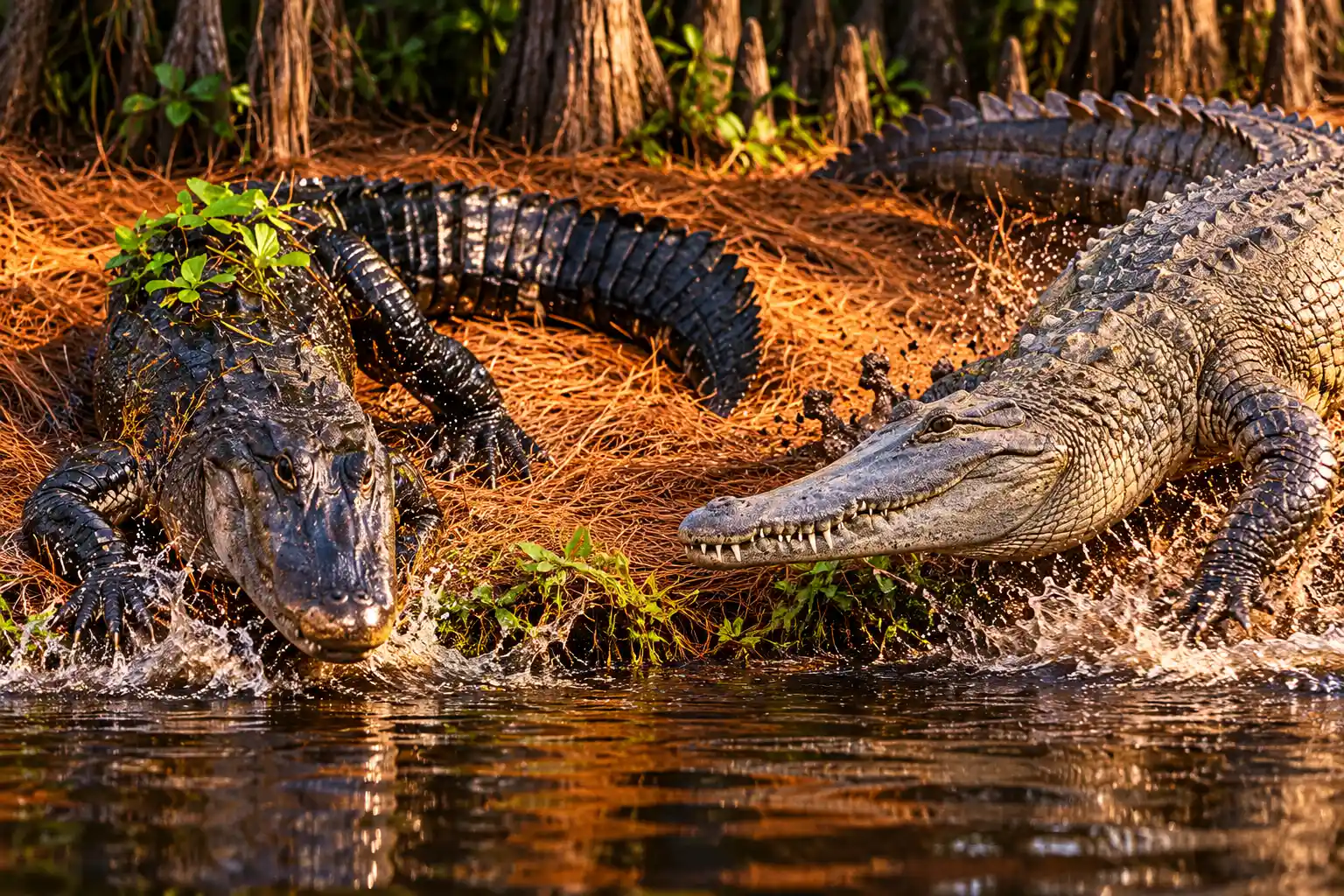
Alligator Snout Shape and Closed Teeth
Start with the snout, from above, and only from a safe distance. An alligator shows a broad, rounded snout with no lower teeth visible when the jaw is shut. People often describe that outline as U-shaped. The American crocodile’s snout is narrow, and the fourth tooth of the lower jaw sticks out when the mouth is closed. On a crocodile, teeth from the upper and lower jaws are both in view when the mouth is shut.
Color is the second pass, not the first. Adult alligators are primarily dark gray, with a lighter underside. Juveniles wear light-colored stripes along the sides, which break up the outline in grass and shadow. American crocodiles are brownish gray and paler than alligators. A shut jaw with a tidy upper row of teeth belongs to the alligator even when the back looks muddy, green, or faded.
The rounded face is the mark that sticks once you have put it beside a narrow one. The tooth check settles a close look, and the snout settles a look from farther off. That farther look is the one to use, because none of these animals should be approached for a better photo.
The American Crocodile on the South Florida Coast
The American crocodile (Crocodylus acutus) is native, and it is a separate species with its own snout and its own coast. Florida is the only place in the world where alligators and crocodiles both live in the wild. Crocodiles use coastal brackish or saltwater ponds, coves, and creeks, with the northern end of their range in southern Florida. Canals sometimes carry them into inland fresh water, so a fresh canal in that southern belt is not an automatic alligator.
Male American crocodiles rarely exceed 14 feet in the wild. That length overlaps the upper end of alligator sizes in the table below, so a very long animal can be either species. The narrow snout and the exposed lower tooth finish the call. Adults are brownish gray and paler than a typical alligator.
In the water, a crocodile hunts fish and other animals it can catch. On land, it crosses between water bodies the same way an alligator does. In coastal South Florida, give either animal the bank, and use the head rather than the county line alone, because both native species can occupy the same stretch of canals.
Spectacled Caimans and Other Nonnative Crocodilians
South Florida also gets crocodilians that do not belong there. The publication on field marks for Florida’s nonnative crocodilians separates them from the two native species. The animal you are most likely to confuse with a small alligator is the spectacled caiman. The Nile crocodile is uncommon and much harder to split from the American crocodile.
Field Marks of a Spectacled Caiman
A spectacled caiman (Caiman crocodilus) can pass for an alligator until you study the head. Check these marks before you file the animal as a young native alligator:
- The head is triangular, and the snout is slightly more pointed than an American alligator’s.
- A bony ridge, called a spectacle, sits on the snout in front of the eyes.
- The body color runs dark brown or olive.
- The species is nonnative, so the sighting should be reported rather than treated as part of the local alligator population.
A photograph of the head is the useful part of that report. Size is a weak reason to skip the call, because a small caiman is still the animal biologists want located.
Nile Crocodile Marks Versus the American Crocodile
A Nile crocodile (Crocodylus niloticus) is very difficult to tell from an American crocodile. The snout is narrow and pointed, and slightly broader than an American crocodile’s. The bony plates along the back form a more symmetrical pattern. Color runs dark olive-brown or dark gray. The species is not commonly found in South Florida, which is why a confident home identification is the wrong goal.
If the animal is clearly a crocodile and you are unsure which crocodile, report it. A photo lets a specialist sort a native American crocodile from a nonnative Nile crocodile. The same report path covers a caiman and a crocodile you cannot place.
HOW TO REPORT A NONNATIVE CROCODILIAN
- The photo: Take a picture that shows the snout, the teeth if the mouth is shut, and any ridge in front of the eyes.
- The spot: Note the location as closely as you can, including the road, canal, or park.
- The report: Call 1-888-IVE-GOT1, or use IveGot1.org or the IveGot1 app.
- The crocodile line: For any crocodile, native or not, also call the University of Florida at (954) 577-6304.
An ordinary American alligator does not need that report. The species is very common, and a routine sighting is not something you have to phone in. Save the call for a caiman, a crocodile, or an animal you cannot match to the broad snout and the hidden lower teeth.
Alligator Size, Age, and Skin Color
Male and female American alligators, and a hatchling beside a breeder, are one species at different points in life. The state length record and the state weight record belong to two different males. One came from Lake Washington in Brevard County, and the other from Orange Lake in Alachua County. Neither record is a crocodile measurement, and neither one names a local subspecies.
| Detail | Figure |
|---|---|
| Female length | Females rarely exceed 10 feet |
| Length record | 14 feet 3 1/2 inches, a male from Lake Washington in Brevard County |
| Weight record | 1,043 pounds, a male 13 feet 10 1/2 inches long from Orange Lake in Alachua County |
| Breeding size | About 7 feet for nearly all alligators; females can breed at 6 feet |
| Years to that size | Females 10 to 15 years; males 8 to 12 years |
| Eggs | About 32 to 46 eggs, laid in late June or early July |
| Days until hatch | About 60 to 65 days, with hatching in late August or early September |
| Active temperatures | Most active between 82 and 92 F |
| Cold thresholds | Feeding stops below about 70 F; dormant below 55 F |
People picture this animal as green. The skin of an adult is dark gray above and lighter below, and a green cast often comes from algae and floating plants stuck to the back. Alligators also pick up the tint of the water around them. A juvenile’s light side stripes fade as the animal grows. That fade is age, and the animal is still an American alligator.
These reptiles do not make their own body heat. Basking, or a move into warmer or cooler air or water, is how they manage temperature. In cold weather they use burrows dug next to an alligator hole or open water, and they still come out to bask during a warm spell. A winter sighting on a sunny bank fits that pattern.
Types of Alligators in Florida by Habitat
The animal you should expect depends on the water in front of you, and the American alligator is the default across the state. The living-with-alligators guide places them in all 67 counties. If the water is a freshwater lake, pond, river, marsh, or suburban canal outside the southern coastal belt, plan on an American alligator.
Along the southern coast, brackish and salt ponds, coves, and mangrove creeks are American crocodile habitat. An alligator can still be there, because alligators use brackish water and are occasionally in salt water. In the other direction, crocodiles show up in inland fresh water where canals tie the coast to neighborhoods. In that region, the county is a hint, and the snout is the decision.
In South Florida, a smaller crocodilian with a triangular head and a ridge in front of the eyes should be handled as a possible spectacled caiman. That is the sighting to photograph and report. A broad snout and a hidden lower tooth row, anywhere in the state, still reads as the American alligator, including in the Everglades, where the two native species share southern Florida and still do not share a head shape.
Living With Alligators and Crocodiles
Serious injuries caused by alligators are rare in Florida. From 2012 to 2022, the state averaged eight unprovoked bites a year that were serious enough to require professional medical treatment. The precautions below are the ones tied to the situations that create conflict: a fed animal, a pet at the waterline, and time in the water outside a designated area between dusk and dawn, when these reptiles are most active.
WHAT TO DO NEAR THE WATER
- The distance: Keep a safe distance if you see an alligator or a crocodile.
- Pets: Keep pets on a leash and back from the water’s edge, because they resemble natural prey.
- Swimming: Swim only in designated areas, during daylight, and without a pet.
- Feeding: Never feed an alligator or a crocodile. Feeding is illegal, and a fed animal can lose its wariness and connect people with food.
- The hotline: If you are concerned, call the Nuisance Alligator Hotline at 866-FWC-GATOR (866-392-4286) so a contracted trapper can be sent if one is needed.
To report someone feeding an alligator or another wildlife violation, call 888-404-3922. That number is separate from the nuisance hotline. The Statewide Nuisance Alligator Program sends contracted trappers after alligators that pose a problem in developed areas, and it leaves alligators in place where they occur naturally. A basking alligator in a wild marsh is not a call. An animal that will not leave a dock, a pool, or a pet’s path is a call to the hotline.
Frequently Asked Questions
Are Alligators Hunting When They Cross a Yard?
An alligator or a crocodile crossing a yard or a road is traveling between bodies of water, and it is not hunting on that walk. Give the animal a clear path back to the water, keep pets away, and do not try to push it with a stick, a hose, or a car. If it settles beside a dock, a pool, or a pet path and will not leave, call the nuisance hotline instead of handling it yourself.
How Many Alligator Hatchlings Reach Adult Size?
From an average clutch size of 35, an estimated 4 alligators reach maturity while numbers are still growing. That average of 35 sits inside the wider count of about 32 to 46 eggs in a nest. Survival is expected to be lower once more of the animals are large, in part because larger alligators eat smaller ones.
Can You Tell Male and Female Alligators Apart by Sight?
You cannot read sex from the snout or the color. Females rarely exceed 10 feet, so a longer animal is more likely male, while an alligator near 7 feet can be either sex because both sexes can breed around that length, and females can breed at 6 feet. Keep the same distance either way.
Why Do Crocodiles Sit With Their Mouths Open?
An open mouth on a basking crocodile is a way to take on heat, and the posture is called gaping. Crocodiles also move into warmer or cooler air or water to change temperature. Alligators bask for heat as well, and they use dens beside the water in cold weather. An open mouth is not a reason to step closer for a picture.
Outside the southern coastal belt, the large reptile in fresh water is an American alligator. In coastal South Florida, the snout and the lower teeth still decide whether you are looking at that alligator, an American crocodile, or a caiman that should be reported.
Disclaimer: This article is an educational guide and is informational only. It is not wildlife-control instruction, a safety certification, or a substitute for directions from the Florida Fish and Wildlife Conservation Commission. Before you approach the water, respond to a sighting, or act on a nuisance animal, contact FWC or a permitted trapper. Figures and rules here reflect FWC, UF/IFAS, and National Park Service sources reviewed for this page and can change.


Brain-IT Rebuilds Seen Images After One Hour of Scans

Middle East Oil Tops Pre-War Marks by Skipping Hormuz

Peacock’s Fast Series Shares 2028 With Fast Forever

NASA and IBM’s Lunar Model Cuts Polar Ice-Map Error

SteelSeries Sells Infinite 8K Mice That Still Need a Dock

Micron’s $22 Billion Deposits Cover Only a Fifth of DRAM

OnePlus 16 Bets on 200MP and a Familiar 3x Sony

How to Change Background Color in Epic Hyperspace: Look and Feel

C Spire Plans a 200-Mile Fiber Line for One Customer

Gag Reflex Removal Surgery Cost: A Guide to Treatment Fees
-
 BUSINESS3 months ago
Micron’s $22 Billion Deposits Cover Only a Fifth of DRAM
-
 NEWS3 months ago
OnePlus 16 Bets on 200MP and a Familiar 3x Sony
-
 TECHNOLOGY3 years ago
How to Change Background Color in Epic Hyperspace: Look and Feel
-
 NEWS2 months ago
C Spire Plans a 200-Mile Fiber Line for One Customer
-
 LIFESTYLE3 years ago
Gag Reflex Removal Surgery Cost: A Guide to Treatment Fees
-

 NEWS2 months ago
The AI Boom Arrived and Workers’ Share Hit a Record Low
-

 NEWS2 months ago
Super Micro Looks Cheap Until You Read the Cash
-

 AUTO2 months ago
CNG and Hybrids Push Alternative Fuels Past Petrol