
GAMING
SteelSeries Sells Infinite 8K Mice That Still Need a Dock
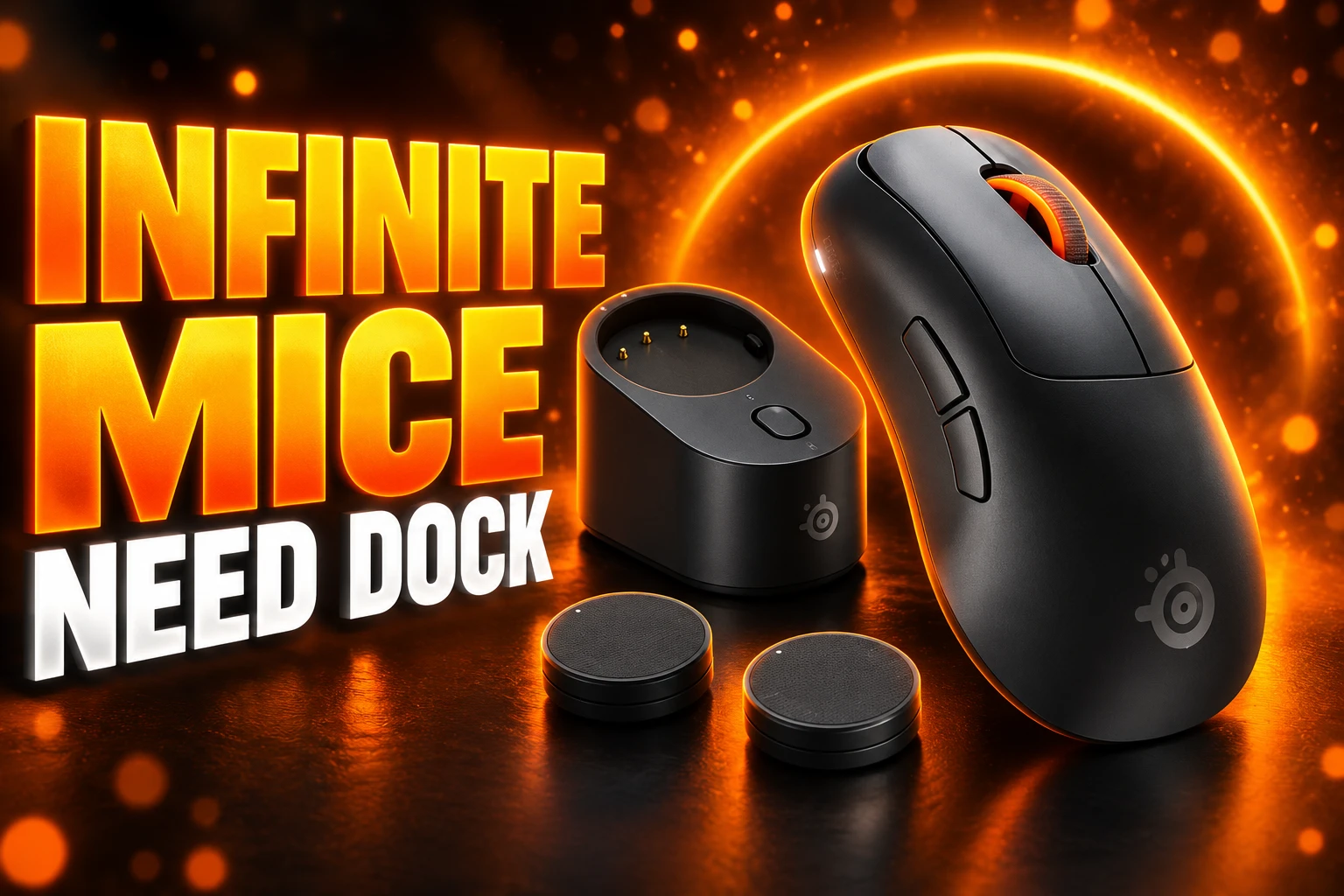
SteelSeries Sensei Pro and Rival Pro 8K mice sell infinite battery life, yet each puck lasts 16 hours at 8K and the travel dongle is $24.99.

SteelSeries is selling the Sensei Pro and Rival Pro at $179.99 as 8K mice with infinite battery life. Each black full-size shell weighs 53 grams, runs a TrueMove 42K sensor, and uses two swappable pucks rated 16 hours at 8,000Hz.
The infinite part is a charging dock on the desk and a second puck you twist in when the first one fades. Stores are due to get all four models on October 13, after pre-orders opened on September 29.
Two Pucks, Not Infinite Runtime
SteelSeries calls the setup the Infinite Power System and sells it as 8K all day. In the Chicago launch note, that means 16 hours per battery at 8K, or 32 hours if you keep both cells in rotation. Drop the polling rate to 1,000Hz and the same pair is rated 60 hours each, 120 hours combined.
Those figures are finite, and they shrink the moment you actually use the feature the mice are priced on. 8,000Hz is the hungry mode. 1,000Hz is how you make a weekend last. The dock is not optional in that math, because the spare has to charge while you play, and the mouse itself is not meant to sit on a cable.
BATTERY LIFE AT 8K AND 1K
- At 8,000Hz: Each puck is rated 16 hours, 32 hours if you rotate both.
- At 1,000Hz: Each puck is rated 60 hours, 120 hours combined.
- The swap cue: A pulsing red LED on the mouse or the dock is the prompt to twist cells.
- The swap itself: Push up, turn counterclockwise, drop in the charged puck, lock clockwise, under 10 seconds.
Hands-on testing over about a week found the spare charging faster than the mouse drained in mixed work, with roughly 20 percent gone after a few hours and about 60 percent restored on the cell in the dock. That ratio is why the slogan can feel true at a desk. It is also why the slogan is a dock plus two cells, not a mouse that never asks you to think about power.
UWB Leaves the 2.4GHz Pile for a Desk Dock
Almost every wireless gaming mouse still shares 2.4GHz with headsets, keyboards, and phones. SteelSeries moved these shells onto ultra-wideband between 6.4GHz and 9.056GHz, a band it says carries about 20 times the bandwidth and can use several channels at once so an 8,000Hz report rate does not collapse in a crowded room.
The 2.4GHz band that nearly every wireless mouse relies on is congested with headsets, keyboards, phones, and every other device in the area, all fighting for the same spectrum.
SteelSeries press release, September 29, 2026
The radio lives in a base station, not a thumb-size dongle you can forget in a laptop bag. A USB-C to USB-A cable feeds that station, which then talks to the mouse over UWB. Plug the station into a PC, an Xbox Series X or S, or a PS5, and the mouse wakes after a two-second hold on the Power/DPI button on its belly. SteelSeries warns that consoles may not expose every setting.
Sensei Pro & Rival Pro with 8K Ultra Wideband
pre-order now: https://t.co/sHr91vjArl pic.twitter.com/XWJFIDt6pX
— SteelSeries (@SteelSeries) September 29, 2026
True 8K here is an 8,000Hz polling rate and a 0.125ms interval, with a 9,000Hz over-poll mode that sends an extra packet for every eight so the PC still sees a solid 8K stream, cutting that interval to 0.111ms. Max Performance Mode keeps the sensor in 8K with 20,000 frame captures a second and the full 800 IPS / 70G tracking envelope. SuperSync in SteelSeries GG can split click reporting from sensor reporting, so clicks stay at 8K while the sensor sits at 1K, 2K, or 4K if a game or a CPU starts to choke.
Four Shapes Share One $179.99 Tag
The Sensei Pro and Rival Pro mice are the same product in two silhouettes. Sensei Pro is symmetrical, with a shallow indent on both edges, and it is the shell for left-handed use as well as right. Rival Pro is the right-hand ergo, taller and a little wider, with a deeper thumb shelf on the left. Mini versions of each cut the footprint and 4 grams.
US pricing is $179.99 for every combination of shape, size, and color. Europe is €199.99. The UK is £169.99. White adds a gram, not a discount. You do not pay less to go small.
THE FOUR SHELLS AT $179.99
| Model | Shape | Black weight | Size (mm) |
|---|---|---|---|
| Sensei Pro | Symmetrical | 53g | 125.6 x 66.5 x 38.6 |
| Sensei Pro Mini | Compact symmetrical | 49g | 118 x 62.5 x 36.2 |
| Rival Pro | Right-hand ergo | 53g | 125.7 x 68.2 x 42.2 |
| Rival Pro Mini | Compact ergo | 49g | 120.7 x 65.4 x 40.5 |
White finishes are 54g on the full-size shells and 50g on the Minis. Each mouse has six buttons: left, right, wheel, a Power/DPI control on the bottom, and two side keys. The side pair is the one most people will remap in SteelSeries GG, to a keyboard key, a media command, an OS shortcut, or a recorded macro. DPI runs from 1 to 42,000 on the TrueMove 42K sensor, a customized PixArt 3955, with five stock steps at 400, 800, 1600, 2400, and 3200 that you can rewrite, including separate X and Y values.
Optical switches are rated for 100 million clicks at 0.35ms. Lift-off and landing sit at 1 by default and can move between 0.7 and 1.7. Click response defaults to 8ms in a 0 to 20ms window, with a warning that leaving 8ms can invite double clicks. Stock feet are white 100% PTFE, and a spare blue set is in the box, plus grip stickers for the buttons and edges.
What a Week of Testing Did to the Scroll Wheel
The clicks have travel and a sharp, clicky note, and the wheel’s ridged tire and even notches felt smooth until charge got low. Around 17 percent battery, that wheel lagged or ignored input. Tweaking GG did not fix it. Swapping the drained puck for the charged one in the dock did.
That stall is the other half of the infinite claim. The cells keep the mouse off a cable, and they also become a performance part. If you wait for empty, you can lose scroll before you lose the cursor. The pulsing red LED is not a courtesy light in that setup. It is the point at which the second puck has to already be ready.
The shells themselves are light plastic with almost no paint beyond status LEDs for DPI on the mouse and polling on the dock. There is no RGB to tune. Finger oil shows on the black units after a long session, which is why the grip kit exists. The Power/DPI button on the bottom means a sensitivity change is a lift. That does not stop 8K from feeling fast on a pad. It does mean $179.99 buys a tool look, not a showpiece.
People coming to these mice cold are treating the puck ritual as the test, not the polling number. Public argument has also split along shape, Sensei or Rival, because the internals do not change. You are choosing a grip on one radio, one sensor, and one battery system.
The $160 Mice Already Running 8K
Razer’s Viper V3 Pro is $159.99, weighs 54g in black, and ships 8,000Hz in the box over 2.4GHz HyperSpeed. Logitech’s G Pro X Superlight 2 is $159.99 and 60g, with LIGHTSPEED 2.4GHz; the standard model tops out at 2,000Hz, while DEX and SE variants reach 8,000Hz with the matching receiver. The SteelSeries pair undercuts the Viper by a gram in black and asks $20 more than both names.
HOW THE $179.99 8K MICE STACK UP
| Mouse | Weight | Radio | 8K in the box | US price |
|---|---|---|---|---|
| Sensei Pro / Rival Pro (black) | 53g | UWB, 6.4GHz to 9.056GHz | Yes, plus 9,000Hz over-poll | $179.99 |
| Razer Viper V3 Pro (black) | 54g | 2.4GHz HyperSpeed | Yes | $159.99 |
| Logitech G Pro X Superlight 2 | 60g | LIGHTSPEED 2.4GHz | Standard model 2,000Hz | $159.99 |
The extra $20 is not a lighter mouse than the Viper. It is UWB, the dock, and the second cell. If your desk already holds a tiny 2.4GHz receiver and you are willing to plug in or park the mouse on a pad charger, the incumbents still sell the 8K number without a base station. SteelSeries is asking you to put a station back on the desk so the mouse never takes a cable.
Fifteen Years of Sensei, Now at 53 Grams
SteelSeries timed the launch to the end of its 25th year. The company was founded in 2001. Sensei arrived in 2011 as the ambidextrous shape. Rival followed in 2013 as the right-hand line. The new Pro series keeps those outlines and restuffs them with UWB, 8K, and the puck dock.
SENSEI AND RIVAL, THEN THE PRO SERIES
- 2001: SteelSeries is founded as a peripherals maker aimed at competitive play.
- 2011: The Sensei ambidextrous mouse is introduced.
- 2013: The Rival line arrives as the right-hand shape.
- September 29, 2026: Pre-orders open for Sensei Pro, Sensei Pro Mini, Rival Pro, and Rival Pro Mini at $179.99.
- October 13, 2026: Retail stores are due to stock the four models.
GG is the tuning layer, with a web app in Chrome or Edge for firmware and basic settings if you do not want the full desktop suite. Rotation control, scroll jump protection, a sensitivity finder, a converter for carrying DPI across games, and a 3D aim trainer sit in that software. Five onboard profiles travel with the mouse. The old Sensei promise was a shape both hands could use. The new one is that shape at 53 grams, still ambidextrous, now tied to a radio that does not live in the mouse alone.
A $24.99 Dongle Is How This Mouse Travels
Move rooms and you move the station and its cable, or you buy the Wireless Travel Dongle. That adapter is $24.99, €24.99, or £24.99, and it is sold only on steelseries.com. Hold Power/DPI and press the wheel to jump between two live radios if both are on. The mouse follows whichever station is active. The second radio is not in the box.
WHAT COMES IN THE $179.99 BOX, AND WHAT DOES NOT
- In the box: The mouse, UWB base station, USB-C to USB-A cable, two battery pucks, grip stickers, and spare PTFE feet.
- On the desk: The station has to stay plugged in if you want the spare charging and the 8K link up.
- Not in the box: The Wireless Travel Dongle at $24.99, required if you want a second system without packing the dock.
- Console caveat: Xbox Series X or S and PS5 can see the mouse; SteelSeries says some features may not run there.
Pre-orders remain open at $179.99 for every shell, with retail listed for October 13. The 8K link is real, the 53-gram weight is real, and the puck swap is quick. So is the fine print: 16 hours at the polling rate they advertised, a scroll wheel that already stumbled at 17 percent, and another $24.99 if the dock is supposed to stay home.

SteelSeries Sells Infinite 8K Mice That Still Need a Dock

Russia Squeezes Ukraine’s Internet From Kyiv to Poland

State AGs and Banks Trap the CLARITY Act Vote

Apple Turns the Old Siri Opt-In Into Model Training

Google Maps Keeps the Speedometer On Without a Route

Micron’s $22 Billion Deposits Cover Only a Fifth of DRAM

OnePlus 16 Bets on 200MP and a Familiar 3x Sony

CNG and Hybrids Push Alternative Fuels Past Petrol

C Spire Plans a 200-Mile Fiber Line for One Customer

The AI Boom Arrived and Workers’ Share Hit a Record Low
-
 BUSINESS1 month ago
Micron’s $22 Billion Deposits Cover Only a Fifth of DRAM
-
 NEWS1 month ago
OnePlus 16 Bets on 200MP and a Familiar 3x Sony
-
 AUTO4 weeks ago
CNG and Hybrids Push Alternative Fuels Past Petrol
-
 NEWS3 weeks ago
C Spire Plans a 200-Mile Fiber Line for One Customer
-

 NEWS1 month ago
Debian Puts Generative AI Risk on Volunteer Submitters
-

 TECHNOLOGY2 years ago
How to Change Background Color in Epic Hyperspace – Personalizing Your EHR Interface
-
 NEWS4 weeks ago
The AI Boom Arrived and Workers’ Share Hit a Record Low
-

 LIFESTYLE3 years ago
Types of Alligators in Florida – Discovering Reptilian Diversity in the Sunshine State